
MONKS JOURNAL · SWEETENER SCIENCE
Monk Fruit
vs. Sugar
They taste similarly sweet. Inside your body, they take two completely different paths.
↓ DISCOVER THE DIFFERENCE
Sugar and monk fruit can taste remarkably similar on the tongue — both deliver that instant, unmistakable sweetness we’re wired to crave. But once they cross from your mouth into your bloodstream, the two part ways completely.
Understanding exactly what happens at that point is the whole reason monk fruit has quietly become one of the most talked-about natural sweeteners of the last few years, and why so many people are actively searching for a sugar substitute that doesn’t ask them to compromise on taste.
01 · THE SUGAR PATHWAY
What Sugar Actually Does Once You Eat It
Table sugar, or sucrose, is made up of two simpler sugars bonded together: glucose and fructose. As soon as you eat it, your digestive system breaks that bond apart. The glucose is absorbed rapidly into your bloodstream, and your blood sugar level rises — sometimes sharply, depending on how much sugar you’ve consumed and what else you ate alongside it.
Your pancreas responds to this rise by releasing insulin, a hormone whose job is to move glucose out of your blood and into your cells, where it can be used for energy or stored for later. This is a completely normal biological process — your body is built to handle occasional sugar intake. The problem is frequency and volume.
The result of repeated glucose spikes throughout the day — that mid-morning coffee with two sugars, the afternoon snack, the post-dinner dessert — is a familiar rhythm many people know intimately: a quick lift in energy and mood, followed by a crash roughly an hour later, often accompanied by fatigue, irritability, or a renewed craving for something sweet.
02 · THE MONK FRUIT DIFFERENCE
What Monk Fruit Does Instead
Monk fruit’s sweetness works on a completely different biological pathway. It doesn’t come from sugar molecules at all — it comes from naturally occurring compounds called mogrosides, found in the pulp and seeds of the monk fruit itself.
Decoction
A slow simmering of dried monk fruit in water — similar to how tea is brewed — draws the mogrosides into a concentrated, intensely sweet extract.
Mogrosides register as sweet to your taste receptors — genuinely, powerfully sweet, somewhere in the range of 150 to 250 times sweeter than sugar by weight — without being metabolized the way sucrose is.
BLOOD SUGAR RISE
INSULIN RELEASE
CALORIES
03 · WHY IT MATTERS
Beyond Weight Loss
It’s easy to file “zero calorie, zero blood sugar impact” under the general umbrella of dieting, but the implications go well beyond a number on the scale. Stable blood sugar is directly tied to energy consistency, mood regulation, focus, and hunger signaling.
Swapping sugar for monk fruit in something as small as your daily coffee or tea removes one of these spikes entirely — a small, low-effort change with a genuinely measurable physiological effect, repeated every single day.
04 · AN 800-YEAR STORY
Too Good to Be True?
It’s a fair and healthy question to ask. But monk fruit’s story is less about a manufactured breakthrough and more about a naturally occurring plant compound that has been used for roughly 800 years in traditional Chinese medicine.
The mogroside sweetness pathway is simply a different sweetness mechanism entirely, one that sidesteps the exact issues that make sugar problematic in large quantities.
TRADITION
05 · SIDE BY SIDE
Sugar vs. Monk Fruit At a Glance
Sugar cane or sugar beet
Dried monk fruit, via decoction
Sucrose
Mogrosides
~4 calories per gram
Effectively zero
Significant spike
No measurable impact
Yes
No
None — it’s sugar
Clean, fruit-forward
06 · START SMALL
Four Easy Ways to Make the Swap
Coffee & Tea
Your highest-frequency daily sugar swap.
Dressings
Balance acidity without spoonfuls of sugar.
Smoothies
Add sweetness alongside naturally sweet fruit.
Baking
With texture adjustments for sugar’s structural role.
QUESTIONS, ANSWERED
Frequently Asked Questions
Does monk fruit raise blood sugar at all?−
No measurable rise has been found in research on mogrosides — they aren’t metabolized as sugars in the body.
Is monk fruit safe for daily use?+
It has a documented history of use spanning roughly 800 years.
Why does monk fruit taste sweet if it has no calories?+
Sweetness and caloric content are two separate things. Mogrosides bind strongly to sweet taste receptors without being broken down for energy like sugar.
THE BOTTOM LINE
Sweetness, Without the Spike.
Sugar sweetens and spikes. Monk fruit sweetens and doesn’t. That single, fundamental difference is why so many people are actively making the switch.
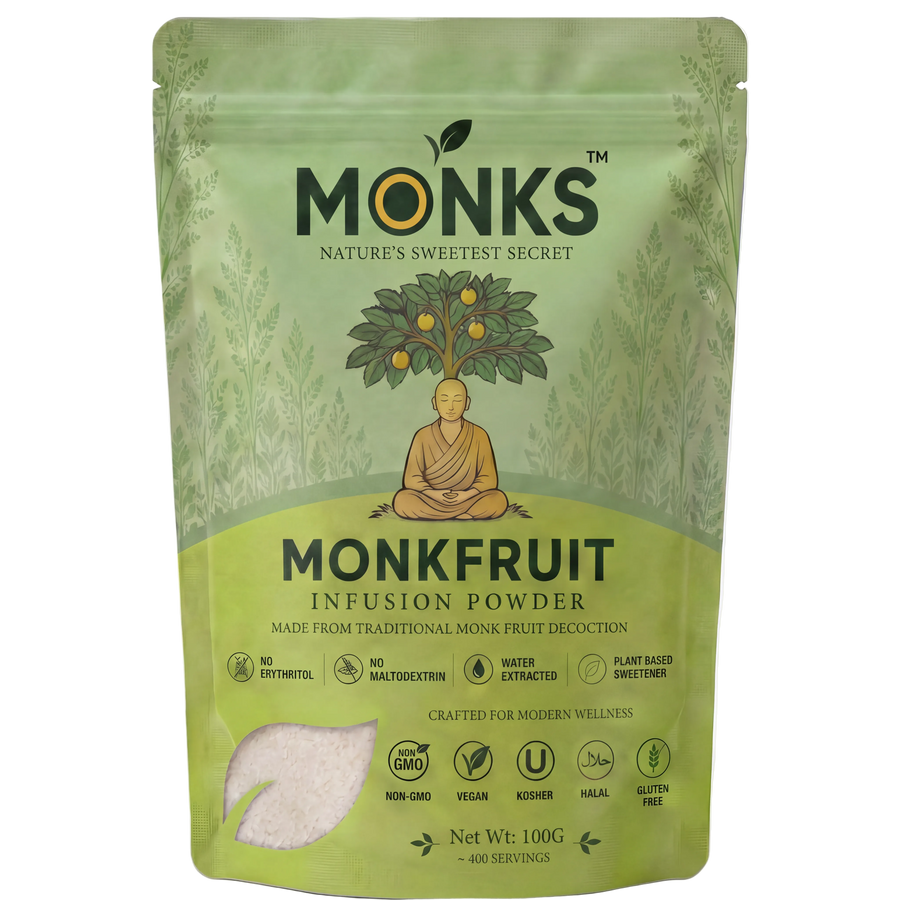
Discover MONKS → MONKS Monk Fruit Decoction Powder and drops are made using the traditional decoction method.