
MONKS JOURNAL · SWEETENER SCIENCE
Scientists Found a Compound
Inside This Fruit
Meet mogrosides — the naturally occurring compounds responsible for monk fruit's remarkable sweetness.
↓ DISCOVER THE SCIENCE
For centuries, people in southern China knew monk fruit was intensely sweet without knowing exactly why.
It took modern chemistry to isolate and name the specific compounds responsible — and once scientists did, they discovered something genuinely unusual.
01 · MEET MOGROSIDES
The Compounds Behind Monk Fruit's Sweetness
The compounds responsible for monk fruit's sweetness are called mogrosides, a class of molecules known scientifically as triterpene glycosides.
They are found concentrated in the pulp and seeds of monk fruit, present in fresh fruit at roughly 0.5 to 0.65% concentration — a small amount that, once extracted and concentrated, delivers remarkably powerful sweetness.
Mogrosides come in several forms, but the most significant is mogroside V, generally considered the primary compound behind monk fruit's characteristic sweet taste and the form most commonly isolated and concentrated in commercial monk fruit extracts.
02 · SWEETNESS INTENSITY
Just How Sweet Is It?
Depending on purity and concentration, mogroside V has been measured at roughly 150 to more than 250 times sweeter than table sugar, gram for gram.
Some research places pure mogroside V's sweetness intensity even higher, in the 250–400× range under laboratory conditions. This extraordinary potency is why monk fruit extract can be used in such tiny quantities compared with sugar.
03 · HOW SCIENTISTS ISOLATED IT
From Traditional Decoction to Modern Analysis
Identifying and isolating mogrosides required careful extraction and chemical analysis, building on monk fruit's much older tradition of simple water-based decoction.
Traditional preparation simply simmered dried monk fruit to draw out its natural sweetness. Modern food science went further — identifying the specific molecules responsible and developing methods to isolate and concentrate them with much greater precision.
Cleaner flavour through improved extraction
A significant milestone came in 1995, when Procter & Gamble patented a process for extracting monk fruit's sweet compounds while removing naturally occurring sulfur-containing compounds that gave raw extract an off-putting flavour.
Removing those interfering compounds was a key step in making monk fruit commercially viable as a mainstream sweetener outside China.
04 · BLOOD SUGAR
Why Mogrosides Don't Behave Like Sugar
Beyond their intense sweetness, mogrosides have a second remarkable property: unlike sucrose, they are not broken down and absorbed by the body as glucose.
Broken down as glucose
Contributes energy and raises blood glucose.
Sweet taste, different pathway
They register on sweet taste receptors without being metabolised as sugar.
This is the core reason monk fruit delivers sweetness with practically zero calories and no measurable blood sugar impact.
05 · WHAT ELSE RESEARCHERS HAVE FOUND
Beyond Sweetness and Metabolism
Ongoing research has explored other characteristics of mogrosides, including antioxidant activity observed in laboratory studies.
Mogrosides have been shown to help neutralise certain reactive oxygen species in vitro. This area is still developing, and laboratory findings do not automatically translate into specific clinical health claims.
Sweetness and blood sugar behaviour are the clearest established properties. Broader antioxidant effects remain an active area of scientific investigation.
06 · QUICK REFERENCE
What We Know About Mogrosides
QUESTIONS, ANSWERED
Frequently Asked Questions
What exactly is mogroside V?−
It is the primary sweet compound found in monk fruit, responsible for much of its characteristic sweetness and commonly isolated in commercial monk fruit extracts.
Why don't mogrosides raise blood sugar?+
They are not broken down and absorbed as glucose during digestion in the same way sucrose is.
Are mogrosides natural or synthetic?+
They occur naturally within monk fruit and are extracted from the fruit rather than synthesised.
THE BOTTOM LINE
The Real Story Behind Monk Fruit
Mogrosides are the real story behind monk fruit's remarkable properties — naturally occurring compounds hiding inside a small fruit from southern China that happen to be among the sweetest and most metabolically unusual substances found in nature.
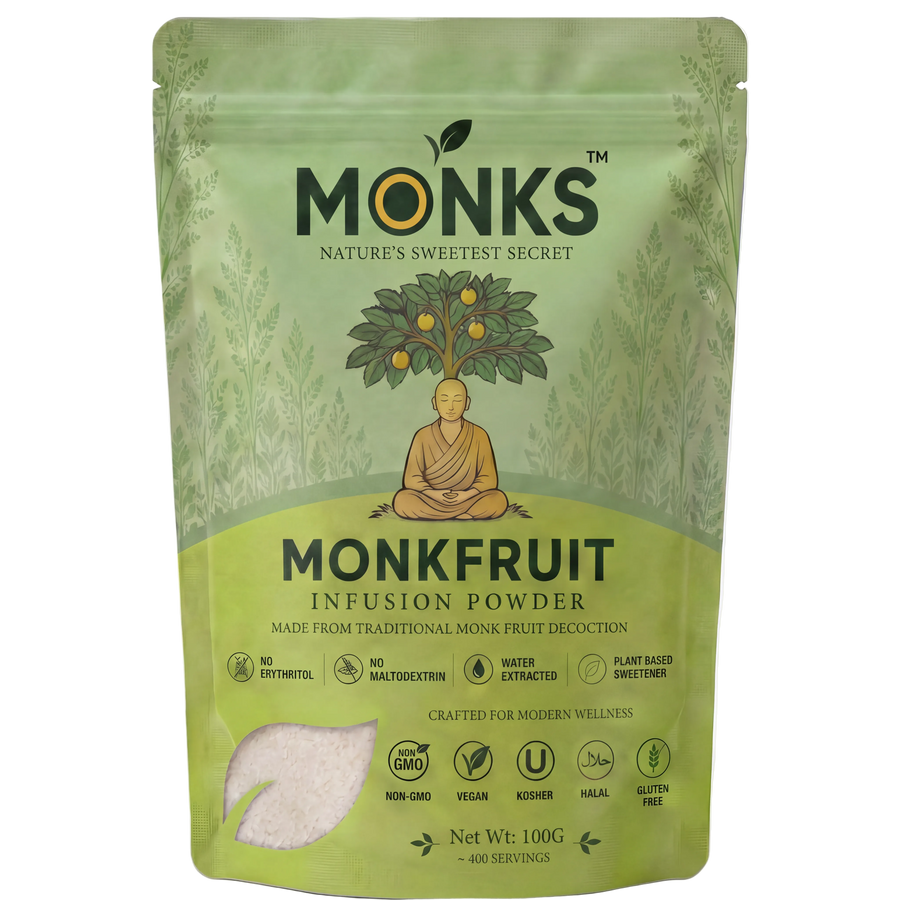
Discover MONKS → MONKS Monk Fruit Decoction Powder is built around these naturally occurring mogrosides — sweetness, straight from the fruit.