
MONKS JOURNAL · ORIGIN STORY
The 800-Year
History of Monk Fruit
From Buddhist monasteries in the mountains of Guangxi to a modern natural sweetener.
↓ BEGIN THE STORY
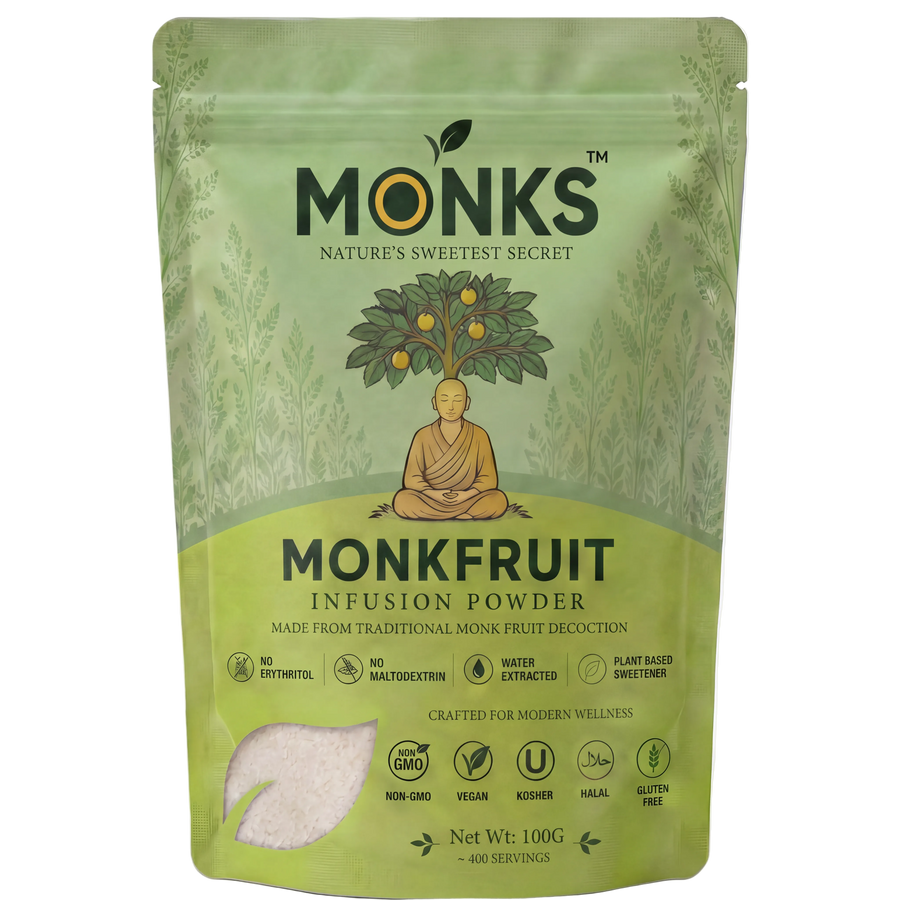
Most modern sweeteners have a birthdate — a laboratory, a patent filing, a specific decade of invention. Monk fruit has something rarer: a genuine, centuries-old story.
Its story is rooted in a specific place, a specific plant, and a specific group of people who nurtured it long before the rest of the world had any idea it existed.
01 · WHERE IT BEGINS
The Mountains of Guangxi
Monk fruit — botanically named Siraitia grosvenorii — grows on vines in the limestone karst mountains of Guangxi Province in southern China, with smaller pockets also found in neighboring Guangdong.
This is a genuinely demanding plant to cultivate. It requires the region's particular combination of high altitude, consistent humidity, and mineral-rich soil to thrive.
The fruit itself is small, round, and turns from green to a dull brown as it dries. Its significance was never about appearance. It was about what happened once the fruit was dried and prepared.
02 · THE NAME
Why It's Called Monk Fruit
Around 800 years ago, during China's Song Dynasty, Buddhist monks living in these remote mountain regions began cultivating the vines around their monasteries.
The association between the fruit and the monastic communities who cultivated and prepared it became so deeply embedded that the name stuck permanently, eventually translated directly into English as “monk fruit.”
03 · LUO HAN GUO
Buddha Fruit, Longevity Fruit
In traditional Chinese medicine, the resulting brew — known as Luo Han Guo, often translated as “Buddha fruit” or “longevity fruit” — was valued not only for its natural sweetness but for its traditional use in supporting the throat, lungs, and digestion.
Decoction
Dried monk fruit is gently simmered in water to draw out its natural sweetness — a process connecting modern MONKS powder back to centuries of monastic preparation.
04 · REGIONAL SECRET
A Mountain Crop For Centuries
For the majority of its history, monk fruit cultivation remained almost entirely confined to this small mountainous corner of southern China.
Growing conditions were passed down through local farming families.
Altitude, shade and soil composition kept cultivation unusually local.
Unlike many ingredients that spread quickly along historical trade routes, monk fruit stayed remarkably local for the better part of eight centuries.
05 · FROM LOCAL TO GLOBAL
How Monk Fruit Reached The Rest of the World
It's only in the last several decades that monk fruit extract began appearing in Western markets in any meaningful way, as global interest in natural, low-calorie sweeteners grew.
Within the past several years, monk fruit has moved from a niche, hard-to-find health-food item into genuine mainstream shelf space.
06 · WHY HISTORY MATTERS
A Tradition That Still Shapes The Product Today
In a sweetener category increasingly crowded with synthetic compounds and modern lab-derived alternatives, monk fruit's 800-year history is worth pausing on.
The traditional decoction method — simmering dried fruit to draw out its natural sweetness — remains the method many producers use, connecting a product on a modern shelf directly back to a process first practiced in Buddhist monasteries centuries ago.
TRADITION
QUESTIONS, ANSWERED
Frequently Asked Questions
How old is monk fruit as a sweetener?−
Monk fruit has been cultivated and used for approximately 800 years, dating back to China's Song Dynasty.
Why is it called “monk fruit”?+
Buddhist monks in the Guangxi mountains first cultivated the plant and prepared it as a sweet traditional tea, and the name stuck through centuries of continued association.
Where does monk fruit grow today?+
It's still predominantly grown in Guangxi Province, China, though cultivation has expanded modestly to other suitable growing regions as global demand has increased.
BRINGING TRADITION FORWARD
An 800-Year-Old Story For Modern Kitchens
Whether you're stirring it into your morning coffee or baking with it for the first time, monk fruit carries something rare: a continuous story, unbroken across centuries, connecting a small mountain fruit to a Buddhist monastery to the jar on your kitchen counter today.
Discover MONKS → MONKS makes its Monk Fruit Decoction Powder using that same traditional method — dried fruit, gently simmered, the way it's been done for centuries.