
MONKS JOURNAL · UK REGULATION
The UK Government
Banned This Natural Sweetener
The true story of monk fruit, the “novel food” classification, and the 2024 High Court ruling that changed everything.
↓ WHAT REALLY HAPPENED
This one is not clickbait. For a period of time, traditional monk fruit products were effectively restricted in the UK because they were classified as a “novel food.”
It took a High Court case to change that. Here is what actually happened.
01 · THE RULE
What “Novel Food” Actually Means
Under UK and EU food law, any food or ingredient not consumed to a significant degree before 15 May 1997 can be classified as a novel food.
The rule exists to protect consumers from genuinely new and untested ingredients. The problem was that monk fruit was not new at all.
02 · WHY MONK FRUIT GOT CAUGHT
800 Years Old — But Not Mainstream in Britain
Despite monk fruit having roughly 800 years of documented use in China, it was not part of mainstream UK diets before 1997.
The FSA initially classified traditional monk fruit decoctions as novel food, which meant special authorisation was technically required before sale.
03 · THE TURNING POINT
The 2024 High Court Ruling
In March 2024, the High Court of England and Wales ruled that the FSA had been wrong to classify monk fruit decoctions as a novel food.
The classification was wrong
The court found that the FSA had applied overly rigid criteria that were not required under the regulations.
In June 2024, the FSA formally determined that non-selective aqueous decoctions of monk fruit made from fresh or dried fruit are not novel food in Great Britain.
04 · WHY THE METHOD MATTERS
Decoction vs. Highly Purified Extract
Traditional aqueous decoction
Fresh or dried fruit simmered in water using the historic method.
Highly purified extracts
Very high-purity isolated mogrosides remain subject to a different regulatory position.
The production method is not just a heritage detail. It affects regulatory clarity.
05 · THE TIMELINE
From Ancient Use to Legal Clarity
QUESTIONS, ANSWERED
Frequently Asked Questions
Is monk fruit legal in the UK now?−
Traditional monk fruit decoctions are confirmed as not novel food and can be sold as a regular food ingredient without special novel-food authorisation.
Was monk fruit actually “banned”?+
It was placed in a category requiring special authorisation before sale, which functioned as a practical restriction until the 2024 ruling clarified its status.
Does this apply to every monk fruit product?+
No. The determination specifically covers traditional aqueous decoctions. Highly purified extracts remain a separate category.
THE BOTTOM LINE
Not Unsafe. Misclassified.
The UK did not restrict monk fruit because of a health concern. It was caught in a regulatory technicality designed for genuinely new ingredients. The 2024 ruling clarified that traditional monk fruit decoctions are not novel food.
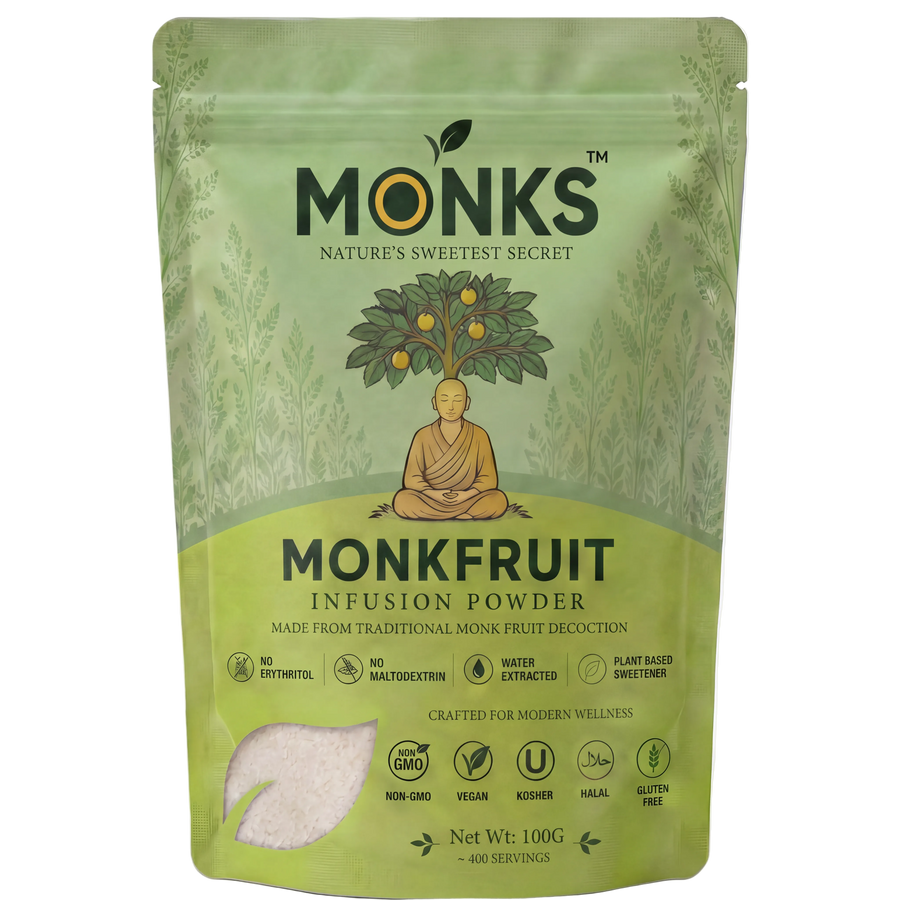
Discover MONKS → MONKS Monk Fruit Decoction Powder is made using the traditional method now formally recognised under UK regulation.