

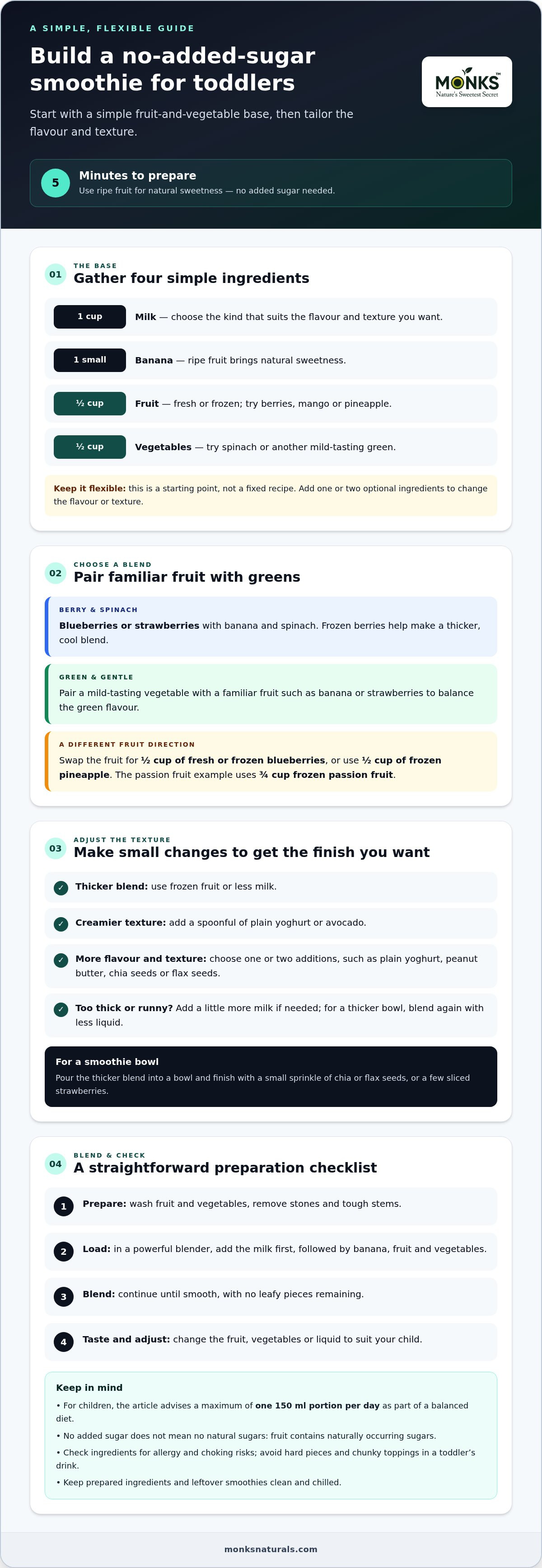
Skip the added sugar, not the flavour. A simple toddler smoothie takes 5 minutes to prepare and starts with 1 cup of milk, 1 small banana, ½ cup of fruit and ½ cup of vegetables. These healthy smoothie recipes for kids without sugar use fruit for natural sweetness, rather than added sugar.
It’s easy to see why smoothies appeal on busy mornings: they’re quick to blend and easy to adapt to what’s in the fridge or freezer. Keep the ingredients simple so the fruit and vegetables shine without added sweeteners.
Here, you’ll find a flexible fruit-and-vegetable base, ideas for blending spinach into berry smoothies, and tips for choosing milk. You’ll also learn how to interpret nutrition per serving and find a bright Good Morning, Sunshine smoothie idea for a little variety. Start with the base, then adjust the ingredients and texture to suit your child.
Key Takeaways
- Build a flexible smoothie from fruit, vegetables and a milk of your choice, then adjust the texture with the liquid.
- Blend spinach with berries for a simple way to bring greens into a fruit smoothie.
- Compare nutrition per serving, and distinguish naturally occurring sugars from added sugars.
- Choose a milk that suits the flavour and texture you want, including an unsweetened plant-based option.
- Try the Good Morning, Sunshine recipe for a bright fruit blend, and adapt the ingredients to suit your family’s routine.
1. A flexible fruit-and-vegetable smoothie base for toddlers
For an easy smoothie with no added sugar, blend 1 cup of milk, 1 small banana, ½ cup of fruit and ½ cup of vegetables. This flexible toddler recipe takes 5 minutes to prepare. Choose ripe fruit for sweetness, then add 1-2 optional ingredients to change the flavour or texture.
For breakfast, try strawberries with spinach and banana, or blueberries with avocado and mild greens. Fresh or frozen fruit works, and frozen pieces make a thicker blend. In a powerful blender, add the milk first, followed by the banana, fruit and vegetables. Blend until smooth, adding a little more milk if needed.
Treat the base as a starting point, not a fixed recipe. Swap mango for ½ cup of frozen pineapple, or use ½ cup of fresh or frozen blueberries. For a green smoothie, pair a mild-tasting vegetable with a familiar fruit such as banana or strawberries. This lets you adjust the colour and taste without adding sugar.
- For a berry blend: combine blueberries or strawberries with banana and spinach.
- For a creamier texture: add a spoonful of plain yoghurt or avocado.
- For a thicker bowl: use less milk, then add fruit and seeds on top.
Suitable protein and fibre-rich additions include plain yoghurt, peanut butter, chia seeds and flax seeds. Harvard Health Publishing notes that smoothies can combine fruit and vegetables with yoghurt, nut butters, chia seeds or flax seeds. Peanut butter adds a familiar flavour; one tablespoon contains about 4 grams of protein. Choose one or two additions so the fruit remains easy to taste.
For a smoothie bowl, pour the thicker blend into a bowl and finish with a small sprinkle of chia or flax seeds. Add a few sliced strawberries for colour and a soft contrast in texture. If the mixture is too runny, blend it again with less liquid rather than relying on extra toppings to thicken it.
Frozen greens are another practical option. Keep them in a zip-top freezer bag for up to 3 months, ready to blend into a berry smoothie. Start with the base, taste the blend, then adjust the fruit, vegetables or liquid to suit your child.
Frozen passion fruit can give the base a different fruit direction: the recipe uses ¾ cup of frozen passion fruit. Blend it with the milk and vegetables, then taste before making any further changes. Its frozen form also fits the approach of using frozen fruit for a thicker blend. Another example shown on the page is 21-month-old Anna eating a banana, cocoa, ice, milk and cashew nut smoothie. That combination offers a different flavour profile from the berry and green combinations, while keeping fruit and milk in the mix. When adapting ideas like these for a toddler, keep the texture smooth and adjust the liquid gradually. The recipe and pictured smoothie are options to consider alongside the flexible base, rather than requirements for every blend.
2. Nutrition information per serving
For children, keep smoothies to a maximum of one 150 ml portion per day as part of a balanced diet. Treat this as a serving limit, not a claim that blended fruit contains no naturally occurring sugar. A smoothie made with banana and berries can have no added sugar whilst still containing sugars from the fruit.
Read nutrition information per serving, then compare it with the ingredients and portion size. Recipe figures vary: one smoothie listing gives 0g of added sugars and 40g of total sugars, whilst a low-sugar berry recipe contains 11 grams of sugar. These figures describe different recipes, not a standard smoothie. Total sugars include natural fruit sugars; added sugars are a separate figure.
Other recipe listings show why serving context matters. One serving is listed as 161 kcal, with 4 g of fibre and 2 g of protein. A separate recipe makes two servings, so dividing the finished blend evenly is important when using its nutrition information. Check whether the stated values refer to the whole recipe or one portion.
For a creamy smoothie without sweetened yoghurt or ice cream, blend ripe banana, avocado or plain yoghurt with milk. Add the liquid gradually, then blend until the texture suits your child. Peanut butter adds flavour and protein, but is also a potential allergen. Choose ingredients for your child’s needs, not simply to raise a nutrition number.
An even texture depends on preparation as well as the blender. Wash fruit and vegetables, remove stones and tough stems, then blend until smooth. Serve in a small cup or a reusable pouch designed for food. Fill it carefully, seal it securely and clean it thoroughly after use. For a young child, a pouch should not replace supported, seated mealtimes.
Check each ingredient for choking and allergy risks before blending. Remove hard pieces such as fruit stones, and avoid whole nuts or other chunky toppings in a toddler’s drink. Nut butters should be smooth and thoroughly blended; leave them out if your child has a relevant allergy. Keep prepared ingredients and leftover smoothies clean and chilled, and discard anything left out or handled unsafely.
For a favourite recipe, note the ingredients, finished quantity and portion served. This makes the nutrition figures easier to interpret next time. Changing the milk, yoghurt or fruit will also change the nutrition per serving.
For children, keep smoothies to a maximum of one 150 ml portion per day as part of a balanced diet.
3. Adding spinach to berry smoothies
Spinach blends into berry smoothies alongside familiar fruit, such as blueberries and strawberries. One recipe uses 2 cups of fresh spinach, showing how greens can form a generous part of the mix. Add the leaves with fruit and milk, then blend until no leafy pieces remain. Frozen berries help create a thicker texture and bring a cool, fruity taste.
These healthy smoothie recipes for kids without sugar pair mild spinach with naturally sweet-tasting fruit. Banana, strawberries and blueberries help balance the green flavour without syrup or honey. Start with a berry-forward blend, taste it, then adjust the fruit or liquid to suit your child.
For a simple combination, blend spinach with ½ cup of blueberries and ¼ of a frozen banana. Add milk gradually and blend until smooth. Banana softens the sharpness of the berries, while the frozen piece chills and thickens the drink. Treat this as a starting point, not a fixed formula. In healthy smoothie recipes for kids without sugar, ripe fruit can add sweetness without a sweetener.
Adding spinach before the liquid can help the blender draw the leaves towards the blades. If you still see flecks, blend the greens with milk first, then add the berries and banana. Scrape down any leaves clinging to the sides, then blend again until the colour is even and the texture smooth.
Frozen spinach works too. Freeze fresh leaves in a zip-top freezer bag and use them within 3 months. Break off a small amount before blending, rather than adding one solid clump. This helps distribute the leaves through the berries and makes the green flavour easier to balance. If you use frozen fruit as well, pour in liquid gradually to keep the mixture moving.
For a different flavour, combine spinach with strawberries and a splash of coconut milk. Coconut has a distinct taste, so use it if your child already enjoys it. Ordinary milk in a similar berry blend lets the fruit lead. To avoid added sugar, skip sweetened yoghurt or syrup and use ripe banana for sweetness instead.
Keep the first taste simple. Offer a small sip, then adjust the next blend if your child prefers more berries, a thinner texture or a less noticeable green colour. Changing one ingredient at a time makes it easier to find a combination they enjoy.
Wash fresh spinach and berries before blending, and remove damaged leaves or soft fruit. Serve the smoothie soon after preparation for the freshest flavour. An evenly blended berry drink can make spinach less prominent while keeping the ingredients familiar and visible.
4. Milk and non-dairy milk options
Milk affects a smoothie’s flavour, texture and nutrition, so choose it to suit the other ingredients. Whole milk makes a berry blend taste fuller; one cup contains 9 grams of protein. For a lighter-tasting mix, unsweetened plain almond milk is an option. The choice also changes how creamy the finished drink feels.
Use the recipe’s liquid amount as a starting point, then pour gradually. A recipe can use ½ cup of almond milk, whilst another smoothie lists 2 cups of unsweetened plain almond milk. These amounts belong to different recipes, not a rule for every blender. Frozen fruit or avocado thickens a blend, so it may need less liquid.
Unsweetened almond milk can suit a smoothie when you want a lower-fat and/or lower-sugar option. Check the carton for added sugars, as sweetened versions change the recipe’s sugar content. With berries, a plain option lets the fruit lead. For banana, orange and mango, choose a milk that complements the fruit.
Plant-based drinks vary in flavour and texture. Almond milk is mild, while coconut milk has a more noticeable coconut taste. Try a little in a familiar berry blend first. If the smoothie is too thin, add avocado or plain yoghurt; if it’s too thick, blend in more milk. Peanut butter can also make a banana smoothie richer.
- For a fuller blend: use whole milk with banana and strawberries.
- For a lighter option: try unsweetened almond milk with berries and orange.
- For a thicker texture: use less liquid and blend in avocado.
Milk choice affects nutrition per serving as well as taste. Whole milk provides protein, while unsweetened almond milk is a lower-fat and/or lower-sugar option. Compare the nutrition label and ingredients, especially when choosing between sweetened and unsweetened cartons. Keep the serving size in mind when comparing values.
For a practical taste test, blend the same fruits twice, changing only the milk. Try strawberries and banana with whole milk, then repeat with unsweetened almond milk. Notice which texture your child prefers. Once you’ve chosen, adjust the liquid gradually, as frozen fruit, yoghurt and nut butter all affect thickness.
For a chocolate banana smoothie, blend bananas, cocoa and ice with enough milk to blend. Vanilla extract and cinnamon are optional. A pictured berry smoothie contains strawberries, milk, whey protein, ice, bananas and mango.
For a mango smoothie, blend Greek yoghurt, a little milk, ice, chia seeds and a dash of maple syrup. This version combines milk with yoghurt.
5. Good Morning, Sunshine smoothie recipe
This bright fruit blend brings orange and dates together for a breakfast smoothie with no added sugar. The recipe makes about 5 cups, using 4 pitted Medjool dates, 1½ cups of water and ½ cup of orange juice. Dates add sweetness from fruit, so skip honey if you want to avoid adding a separate sweetener.
Soak dry or firm dates in hot water for 5 to 10 minutes before blending. This softens them and helps the blender break them down smoothly. Drain the dates, remove any stones, then add them with the water and orange juice. Blend for about 1 minute, until no date pieces remain.
For a thicker, fruitier version, use frozen fruit. One variation combines 1 cup of frozen mango chunks, 1 cup of frozen strawberries and 1 cup of frozen sweet cherries. Another fruit combination includes ½ cup of frozen orange sections and ½ cup of frozen pineapple chunks. Treat these as different ways to shape the flavour, rather than adding every fruit to the same mix.
Choose a blend based on the fruit your child prefers. Mango and strawberries offer a familiar sweet-tart taste, while pineapple and orange bring a brighter edge. Add frozen fruit gradually, blending between additions to control the texture and keep the drink pourable.
For a creamier result, blend in plain Greek yoghurt or whole-milk plain strained yoghurt. One version uses ½ cup of plain Greek yoghurt, while another lists ½ cup of whole-milk plain strained yoghurt. Blend the fruit and liquid first, then add the yoghurt and pulse until combined. Choose plain yoghurt to avoid adding a sweetened one.
Try these practical adjustments:
- For a thinner drink: blend in more water or milk until it pours easily.
- For a chilled texture: include frozen fruit, or blend with 4 ice cubes.
- For extra thickness: stir in 2 tablespoons of chia seeds and leave the smoothie to stand for 5 to 10 minutes.
Keep the first version simple: dates, water and orange juice make the base. Taste it before adding anything else. If the orange tastes sharp, ripe banana or frozen mango can round out the flavour. If it’s sweet enough already, leave the blend as it is. Pour a child-sized portion and chill any remainder promptly.
MONKS: Monkfruit decoction with soluble tapioca fibre Powder
MONKS’ Monkfruit decoction with soluble tapioca fibre Powder offers another way to sweeten recipes when you want an alternative to sugar. It’s made from whole-fruit decoction using a traditional method of gently simmering monk fruit. Add it only if a smoothie needs extra sweetness; ripe banana, berries and dates can offer plenty of flavour on their own.
The powder is spoonable, so it’s easy to mix into a smoothie or another recipe. Monkfruit decoction Drops offer a liquid alternative. Choose the format that suits how you prefer to add sweetness, and keep fruit at the centre of a child’s blend.
Explore MONKS monk fruit sweeteners if you’d like to learn more.
Make your next blend your own
Let your child’s preferences guide the next smoothie. Note the fruit combinations they enjoy, then vary the greens, liquid or toppings to explore new flavours without making breakfast complicated. Healthy smoothie recipes for kids without sugar still leave room for choice: start with fruit, taste, then decide whether extra sweetness is needed.
For an alternative sweetener in recipes, MONKS offers Monkfruit decoction with soluble tapioca fibre Powder, Monkfruit decoction Drops and The Monks Set. Use a sweetener only when it suits the recipe; fruit smoothies don’t need one.
Contact MONKS to discuss your project or explore the range at your own pace. A small change to the next blend can be a lovely place to start.
Frequently Asked Questions
Which fruits make smoothies naturally sweet without adding sugar?
Ripe bananas, dates, mango, strawberries, cherries and pineapple can add sweetness to a smoothie without added sugar. Pair banana with berries for a milder flavour, or combine mango with orange for a brighter blend. Taste the fruit before blending, since ripeness affects sweetness. If it’s too tart, add more ripe fruit rather than syrup, honey or sweetened yoghurt.
What are healthy smoothie ingredient amounts for one child-sized serving?
Use a small recipe as a base: 1 small banana, ½ cup fruit, ½ cup vegetables and 1 cup milk. The toddler recipe makes 1-2 servings, so divide the finished blend according to your child’s appetite. For a child-sized portion, pour 150 ml and save the rest for another use. Adjust the liquid gradually to control thickness.
Are fruit smoothies healthy for children, and how much is an appropriate portion?
Fruit smoothies can be part of a balanced diet, but a drinkable blend can make fruit easy to consume quickly. Keep the serving measured: the recommended maximum in the article is one 150 ml smoothie portion per day. Offer it alongside meals rather than as an all-day drink, and include whole fruit in other meals so children experience different textures.
How can you make dairy-free, vegan or allergy-friendly smoothies for kids?
For a dairy-free or vegan blend, use an unsweetened plant-based drink and leave out the yoghurt. Almond milk works in fruit smoothies, but avoid it if your child has an almond allergy. Choose ingredients that suit their known allergies, read packaging for allergen information, and keep preparation surfaces and utensils clean. Banana, avocado or blended fruit can add body without dairy.
Do UK NHS guidelines recommend limiting fruit juice and smoothies for children?
The article recommends limiting children’s smoothies to a maximum of one 150 ml portion per day as part of a balanced diet.


