

The sweetener named on the front of a pack doesn’t tell the whole story. If you’re looking for a low FODMAP sweetener UK shoppers can assess with confidence, check the full ingredient list and the serving guidance for the product you plan to use. The ingredients and portion matter just as much as the headline sweetener.
It’s understandable to want a simple answer. A broad “low FODMAP” claim can sound reassuring, but without clear serving guidance it may not tell you what to put in your tea or a recipe. Format also affects the ingredients in a finished product. MONKS offers monk fruit decoction drops and a powder made with soluble tapioca fibre, so assess each product by its own ingredient list rather than relying on the front label.
This guide explains how to read sweetener labels, find relevant serving information and compare powder with liquid drops. It also covers how to approach a new product in line with your own dietary guidance, without assuming that one choice suits everyone or every stage of a low FODMAP diet.
Key Takeaways
- Assess a low FODMAP sweetener UK shoppers are considering by its full ingredient list and serving guidance, not its name alone.
- Use a simple label-checking sequence to distinguish listed ingredients from broad claims such as “natural” or “sugar-free”.
- Compare powder, liquid drops and blends by their format and ingredients. Don’t assume one is more suitable than another.
- MONKS offers monk fruit decoction drops and powder made with soluble tapioca fibre. These details alone don’t establish low FODMAP suitability or certification.
- Try a sweetener in line with your personal guidance and dietitian-led plan, and pay attention to your own response.
What does ‘low FODMAP sweetener’ mean in the UK?
FODMAPs are a group of fermentable carbohydrates found in some foods and ingredients. The term covers different types of carbohydrates, and people may tolerate them differently. The Low-FODMAP diet is a structured dietary approach that can help people with IBS identify foods that may contribute to symptoms. It isn’t a universal diagnosis or a cure, and it’s generally best followed with guidance from a suitably qualified dietitian.
So, what makes a low FODMAP sweetener UK shoppers can use with confidence? The headline sweetener alone can’t answer that. A finished product may contain other ingredients, and the amount used can affect how it fits into an individual plan. Look for product-specific, serving-specific guidance instead of assuming a product is suitable because its main ingredient sounds familiar.
Why the whole product matters more than its headline ingredient
A pack may highlight one sweetening ingredient, while the full recipe also includes fibre, a bulking agent or other additions. Those ingredients are part of the product too. For example, a powder and a liquid may share a headline sweetener but have different ingredient lists. Information about one format doesn’t automatically apply to the other.
Read the complete ingredients list, not just the prominent words on the front. Claims such as “natural”, “plant-based” and “sugar-free” describe other qualities; they don’t establish FODMAP content or suitability by themselves. In the UK, there isn’t a government-regulated low FODMAP standard for products. A general claim is not a substitute for clear, current evidence about the product and the portion concerned.
A label is a useful starting point, but don’t use it to guess that an ingredient is safe or unsuitable. If the finished product has no serving guidance, avoid drawing a firm conclusion from its headline ingredient alone. Check reliable, up-to-date dietary guidance for the relevant ingredient and amount, and follow advice tailored to you.
Low FODMAP is not the same as symptom-free for everyone
People can respond differently to the same food, and tolerance may depend on portion and what else is eaten. Equally, symptoms after using a sweetener don’t prove that a particular ingredient caused them. Other foods, timing and individual factors may be involved. Keep observations in context rather than changing several things at once.
“A sweetener’s place in a low FODMAP diet depends on the full product, the portion and your individual guidance, not its name alone.” Use that principle when comparing labels. Check the relevant serving advice, follow the plan agreed with your dietitian, and record your response if that’s part of your approach. This gives you a clearer basis for decisions than broad front-of-pack wording, without treating one product as right for everyone.
How to check sweetener ingredients and serving guidance
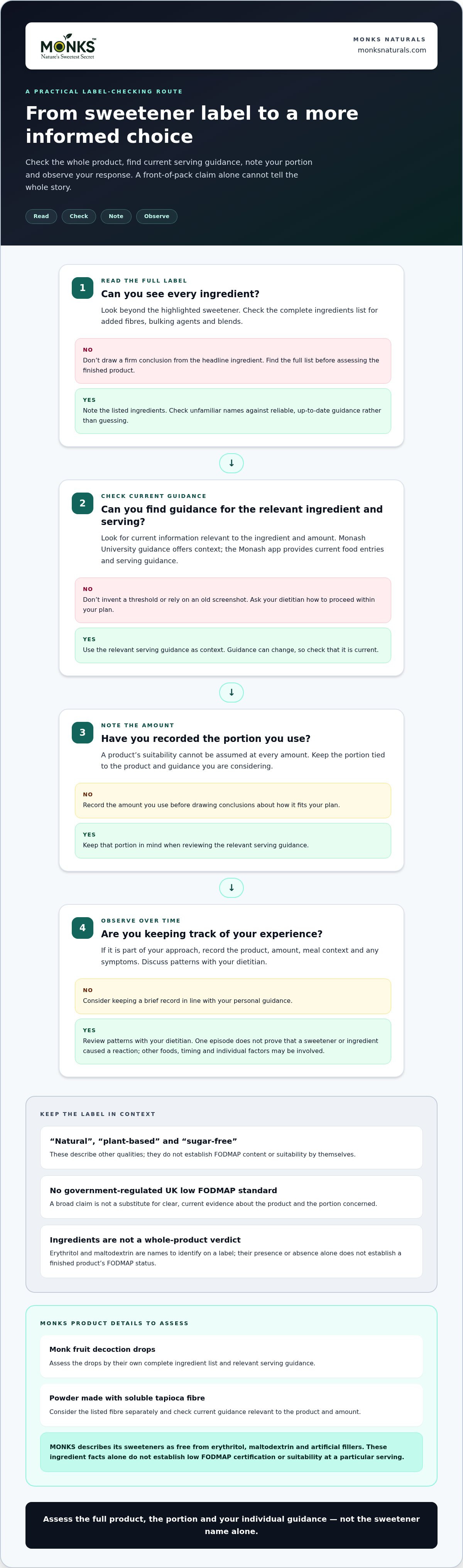
Before adding a new sweetener to your routine, follow a simple sequence: read the whole label, check current FODMAP guidance, note the amount you use, then observe your response. This keeps your decision grounded in the product you have, rather than a broad claim or a guess based on its main ingredient.
- Read: Check the full ingredients list, including fibres, bulking agents and blends.
- Check: Look for current guidance on the relevant ingredient and serving. The Monash University guidance on low FODMAP sweeteners offers context, while the Monash app provides current food entries and serving guidance.
- Note: Record the portion you use. Don’t assume a product’s suitability applies at every amount.
- Observe: Track your experience over time and discuss patterns with your dietitian.
UK food labelling helps you identify what a product contains, but it doesn’t determine the product’s FODMAP status on its own. Likewise, “natural”, “plant-based” and “sugar-free” aren’t substitutes for serving-specific FODMAP evidence. Treat label wording as a description to verify, not a dietary conclusion.
Which label details deserve a closer look?
Scan every listed ingredient, not just the sweetening ingredient highlighted on the front. Look for added fibres and sweetening blends, and note unfamiliar names so you can check them against reliable, up-to-date guidance. Erythritol and maltodextrin are ingredients to identify on a label, but their presence or absence alone doesn’t establish a finished product’s FODMAP status.
MONKS describes its sweeteners as free from erythritol, maltodextrin and artificial fillers. Those are ingredient facts, not evidence of low FODMAP certification or suitability at a particular serving. The powder includes soluble tapioca fibre, so consider that listed ingredient separately and use current guidance relevant to the product and amount. Don’t extend a conclusion about one ingredient to the whole product.
How serving size and personal tracking fit together
Check the current Monash app or other suitable professional guidance for a tested serving where one is available. Entries and guidance can change, so don’t rely on an old screenshot or a serving figure copied from another product. If you can’t find guidance for the relevant product or ingredient, don’t invent a threshold. Ask your dietitian how to proceed within your plan.
Keep a brief record of the product, amount, meal context and any symptoms you notice. One episode doesn’t prove that a sweetener or ingredient caused a reaction. A pattern over time may be more useful to discuss with your dietitian, particularly if you’re following a structured elimination or reintroduction plan.
Label-checking rule: Match the complete ingredient list to current, serving-specific guidance, then follow your personalised plan. For a practical comparison of formats and ingredients, explore MONKS monk fruit sweeteners and assess each product using the same careful steps.
Powder, liquid drops and other sweeteners: what should you compare?
Format affects how a sweetener fits into a cup of tea, a recipe or your kitchen routine. It doesn’t determine low FODMAP suitability. When comparing a low FODMAP sweetener UK shoppers are considering, assess each finished product by its own ingredient list and any current, serving-specific evidence. Products with the same headline sweetener may still have different formulations.
| Format | Practical differences | What to check |
|---|---|---|
| Powder | Can be spooned into a drink or recipe. Its texture may suit some uses better than others. | Check the full ingredients, including added fibres or bulking ingredients, and look for guidance relevant to the product and portion. |
| Liquid drops | Can be added directly to a drink or mixture. Measuring drops may feel different from spooning powder. | Read the liquid product’s complete label and serving directions. Don’t transfer serving evidence from a powder to drops. |
| Other blends | May combine sweetening ingredients with other components to create a particular format or use. | Identify every ingredient, the stated serving size and any current testing information for that exact product. |
What changes between powder and liquid drops?
Powder is easy to spoon, while drops can be stirred directly into a drink. Neither format is automatically easier to measure accurately, and they aren’t nutritionally interchangeable by default. Formulations vary, and powders may contain added ingredients, so inspect the exact label rather than generalising from another product. MONKS’ monk fruit decoction powder includes soluble tapioca fibre. See the monk fruit powder with tapioca fibre and assess its composition separately.
Think about taste, convenience and recipe function as practical preferences, not evidence of FODMAP status. A product that dissolves neatly or suits your baking routine still needs to be assessed by its ingredients and relevant serving guidance. Choose a format that works for the way you prepare food, then evaluate its dietary fit independently.
How to compare blends without relying on front-of-pack claims
Compare like with like: the full ingredient lists, stated serving sizes and any relevant current testing for each finished product. “Natural” doesn’t tell you a FODMAP result or tested portion. “Erythritol-free” tells you that erythritol is absent, but it doesn’t establish the FODMAP status of the remaining ingredients or the product as a whole.
MONKS describes its sweeteners as free from erythritol and maltodextrin, but those exclusions are ingredient information, not proof of low FODMAP certification or suitability. Keep the categories distinct: taste and recipe performance help you decide how to use a sweetener; evidence and your personalised guidance help you assess whether it fits your dietary plan. Don’t rank powders, drops or blends without comparable, verified serving data.
How to try a sweetener carefully while following low FODMAP guidance
Trying a new sweetener can be a small, considered step, not a reason to restart or extend a restrictive phase. Let your dietitian-led low FODMAP plan guide you. Before using a product, check current guidance for its ingredients and the relevant serving. If there’s no product-specific information, don’t assume a universal starter amount. Ask your dietitian how it fits your plan.
A simple, measured approach to introducing a product
Where it suits your professional guidance, change one variable at a time. Keep the rest of the meal familiar so you’re not trying several new ingredients together. Follow any relevant serving guidance, and note what you used and how. This gives you a more useful record than changing multiple foods and trying to guess what might have contributed to a response.
- Check first: Review the complete product label and current guidance for the ingredients and serving.
- Keep the context steady: Use it with a familiar meal or drink, following the approach agreed with your dietitian.
- Write it down: Record the product, amount, meal context and any symptoms, including when they occurred.
Be precise in your notes. “Used sweetener” is less helpful than recording the product and the portion you actually added. If you switch from powder to drops, treat that as a different product rather than assuming the same evidence or amount applies. This helps you discuss observations without treating one experience as a firm conclusion.
When to seek individual dietary advice
A FODMAP-trained dietitian can help if you’re unsure how to introduce a product, interpret serving guidance or move through reintroduction. Seek personalised advice if symptoms persist or your plan feels difficult to manage. Symptoms can have more than one cause, and their timing alone doesn’t prove that a sweetener or FODMAP was responsible.
The low FODMAP approach isn’t intended to mean prolonged restriction without review. Keep your dietitian involved, especially before changing your plan or drawing conclusions from your notes. A sweetener choice can’t diagnose IBS, explain every symptom or replace medical advice. If you have concerns about your health, speak with an appropriate healthcare professional.
If you’re comparing options, use the same measured process for each product and follow the guidance that applies to you. Explore MONKS monk fruit sweeteners as products to assess by their format and ingredients. Don’t assume that either drops or powder suits every person or stage of a low FODMAP plan.
Where MONKS monk fruit sweeteners fit into a low FODMAP routine
MONKS offers two formats to assess within your own low FODMAP plan: monk fruit decoction powder made with soluble tapioca fibre, and pure liquid drops. They offer different ways to sweeten drinks or food, but format alone can’t tell you whether a product suits your needs. For anyone comparing a low FODMAP sweetener UK option, consider how the exact product and portion fit current guidance and your dietitian’s advice.
What MONKS products contain, and what that does not prove
The powder’s soluble tapioca fibre is one ingredient to consider as part of the complete product. The separate liquid drops are another format, with their own label to review. You can view the monk fruit sweetener powder listing when reviewing the powder, but don’t assume guidance for one format applies to the other.
MONKS describes its sweeteners as free from erythritol, maltodextrin and artificial fillers. These are formulation facts. Their absence doesn’t establish low FODMAP certification or prove that either product is suitable for every person or serving. Nor does naming one ingredient, such as tapioca fibre, settle the status of the finished product. Consider the entire formulation and look for current evidence relevant to the product and amount you intend to use.
Keep three things distinct: what the product contains, what serving guidance says and how it fits your individual plan. If current guidance doesn’t cover the product or relevant serving, avoid filling the gap with assumptions. Your dietitian can help you decide how to approach it, particularly during a structured elimination or reintroduction phase.
Choose a format that fits your routine and guidance
Powder may feel familiar to spoon into a recipe or drink; drops may suit someone who prefers a liquid format. These are practical differences, not medical recommendations. Neither format should be ranked as more suitable without comparable, verified serving information. Check the current label for the exact product, then use the guidance that applies to you.
If a product fits your plan, its place in a daily routine can come down to how you prefer to sweeten a morning drink or prepare food. Keep the portion and your dietitian’s advice central, and treat personal observations as information to review rather than proof of cause. That approach lets you consider MONKS products without making an unsupported low FODMAP claim.
For a closer look at the available formats, explore MONKS monk fruit sweeteners and compare the product details with your current serving guidance and dietary plan.
Make your next sweetener choice with confidence
Your next step doesn’t need to be complicated. Before choosing a low FODMAP sweetener UK option, keep your current dietary guidance close and compare it with the product information and serving you’re considering. If you’re unsure how a product fits, take that question to your dietitian rather than relying on a broad claim or making several changes at once.
The most useful choice is one you can assess clearly and use in a way that feels practical. Take it steadily. A thoughtful check is more valuable than rushing towards a supposedly perfect answer.
MONKS offers monk fruit decoction sweeteners in powder and liquid formats, with the powder made with soluble tapioca fibre. The brand states its products are free from erythritol, maltodextrin and artificial fillers. These formulation details aren’t proof of low FODMAP suitability, so use your own guidance when assessing them. Explore MONKS monk fruit sweeteners and compare the options with your routine and personalised plan.
Frequently Asked Questions
Is monk fruit sweetener low FODMAP?
It depends on the complete product and the serving, not simply the monk fruit name. A powder may include other ingredients, so check its current label and relevant Monash guidance for the product and amount. Don’t assume a sweetener has been tested or certified unless you can verify that information. If you’re following a low FODMAP plan, your dietitian can help you decide how it fits your individual guidance.
Can I use tapioca fibre on a low FODMAP diet?
Don’t assume tapioca fibre suits every person or amount. Check current, serving-specific Monash guidance where available, and consider how the fibre appears in the finished product. Its presence alone doesn’t establish the product’s FODMAP status. If you’re in an elimination phase, follow the plan you agreed with your dietitian rather than introducing an ingredient based on a general claim or advice that doesn’t account for your circumstances.
How much sweetener can I have on a low FODMAP diet?
There isn’t one reliable amount that applies to every sweetener product. Formulations differ, and guidance for one product or ingredient shouldn’t automatically be transferred to another. Check the label and current product-specific serving information before deciding how to use it. If no tested serving is available, don’t treat a guessed portion as a guarantee. A FODMAP-trained dietitian can help you make a choice that fits your plan.
What should I look for on a low FODMAP sweetener label?
Start with the complete ingredients list, including fibres, bulking agents and blends, then check whether current guidance relates to that exact product and portion. Claims such as “natural”, “sugar-free” or “erythritol-free” describe separate product attributes; they don’t prove low FODMAP suitability. Keep the packaging or a clear photo of the ingredients and serving directions. That makes it easier to discuss the specific product with your dietitian.
Are liquid sweetener drops better than powder for a low FODMAP diet?
Neither format is automatically better for a low FODMAP diet. Drops and powders may have different formulations, so assess each product separately rather than transferring guidance between them. A short ingredient list can be easier to review, but it isn’t a substitute for relevant evidence about the product and serving. Choose the format that works for your drink or recipe, then consider its dietary fit using your current guidance.
What happens if a sweetener causes symptoms?
Pause using it and note the product, amount, meal context and timing, but don’t assume one episode identifies the cause. Other ingredients or circumstances may be involved, and symptoms alone don’t confirm FODMAP exposure. Follow advice from your clinician or dietitian, particularly if symptoms persist, worsen or are new. A professional can help you review any pattern without making unnecessary restrictions or treating a sweetener as a diagnosis.
Does erythritol-free mean a sweetener is low FODMAP?
No. “Erythritol-free” means that erythritol isn’t included; it doesn’t establish the status of the other ingredients or the finished product at a particular serving. Review the whole label and look for current product-specific guidance. Apply the same care to claims such as “natural”, “vegan” or “sugar-free”. Each describes a different attribute, so none should be used on its own to select a low FODMAP sweetener UK shoppers can rely on.


