

The best sugar substitutes for baking depend on the recipe and the sweetener’s form. A sugar-free baking conversion chart gives you a starting point: date sugar can replace sugar at a 1:1 ratio, whilst monk fruit blend conversions vary by brand, so follow the pack instructions. Liquid sweeteners need a different approach because they also add moisture.
It’s easy to assume that swapping the sweetener is the whole job. But sugar also affects texture, volume and browning, so the same measure won’t suit every cookie, cake or muffin. A small adjustment can be the difference between a tender crumb and a bake that’s too wet or too dark.
Use this guide to compare sweeteners, convert common cup and spoon measures, and choose a practical starting point for different bakes. It explains how granulated, powdered and liquid options behave, and what to adjust when a substitute changes a recipe’s structure or colour. Match the sweetener to the bake, then account for its form.
Key Takeaways
- Choose a sweetener by the bake: texture and form matter as much as sweetness.
- Use the conversion chart as a starting point, then adjust liquid ingredients when a syrup replaces granulated sugar.
- Keep the recipe’s structure in mind; sugar contributes more than sweetness to the finished crumb.
- Watch colour as your bake cooks, since some liquid sweeteners can encourage earlier browning.
- Compare cup, tablespoon and teaspoon measures to make smaller recipe adjustments with confidence.
Choosing sweeteners for cookies, cakes and muffins
The best sweetener depends on the bake’s texture, moisture and desired sweetness. Use a sugar free baking conversion chart as a starting point, then choose a form that suits the recipe. Granulated sweeteners can help cookies stay crisp, while powdered options work well in cakes, muffins and cupcakes.
Date sugar is a granulated sweetener made from dates. It can replace sugar at a 1:1 ratio, although it is less sweet than cane sugar. Its texture makes it a useful option when a recipe needs dry ingredients rather than extra moisture.
Liquid sweeteners add moisture as well as sweetness. For each cup of sugar, use ⅔ cup of agave syrup and reduce other liquids by ⅓ cup. Maple syrup can be used as a sweetener in baking, but the amount may need to suit the recipe. These swaps can make batter wetter, so measure the liquids carefully.
Unrefined sugars are less processed sweeteners, including coconut sugar and maple sugar granules. Coconut sugar can replace sugar at a 1:1 ratio, as can maple sugar granules. They behave more like granulated sugar than syrup, making them easier to use in recipes where added liquid could alter the crumb.
Artificial sweeteners are manufactured sugar substitutes, while stevia is a plant-derived sweetener often sold in concentrated form. Stevia is described as 300 times sweeter than sugar, so a small measure can replace a larger quantity. Because removing sugar also removes bulk, adjust the recipe to account for the missing weight.
Sugar alcohols are sweeteners such as erythritol and xylitol, with sweetness ranging from 25-100% of sugar. Sugar alcohols and other substitutes aren’t interchangeable safety categories. Some sugar alcohols can cause digestive discomfort; use the product’s serving guidance and pay attention to how your body responds.
No-bake sweeteners dissolve without oven heat. In mousse or cheesecake, liquid sweeteners can help prevent a grainy texture; they also dissolve readily in drinks. Taste as you mix, since the finished sweetness depends on the recipe and the sweetener’s concentration.
Sweetener blending combines different types to balance flavour. Some sugar-free baking guidance recommends blending sweeteners to reduce aftertaste. For example, pair a concentrated sweetener with a bulkier granulated option, then adjust gradually. This can help balance flavour in your baking.
UK cup-to-gram conversion has no single measure for every sugar-free ingredient. Cups measure volume, while grams measure weight, and powders, granules and syrups have different densities. Weigh the specific sweetener using its packaging guidance; don’t assume it weighs the same as sugar.
Printable conversion chart
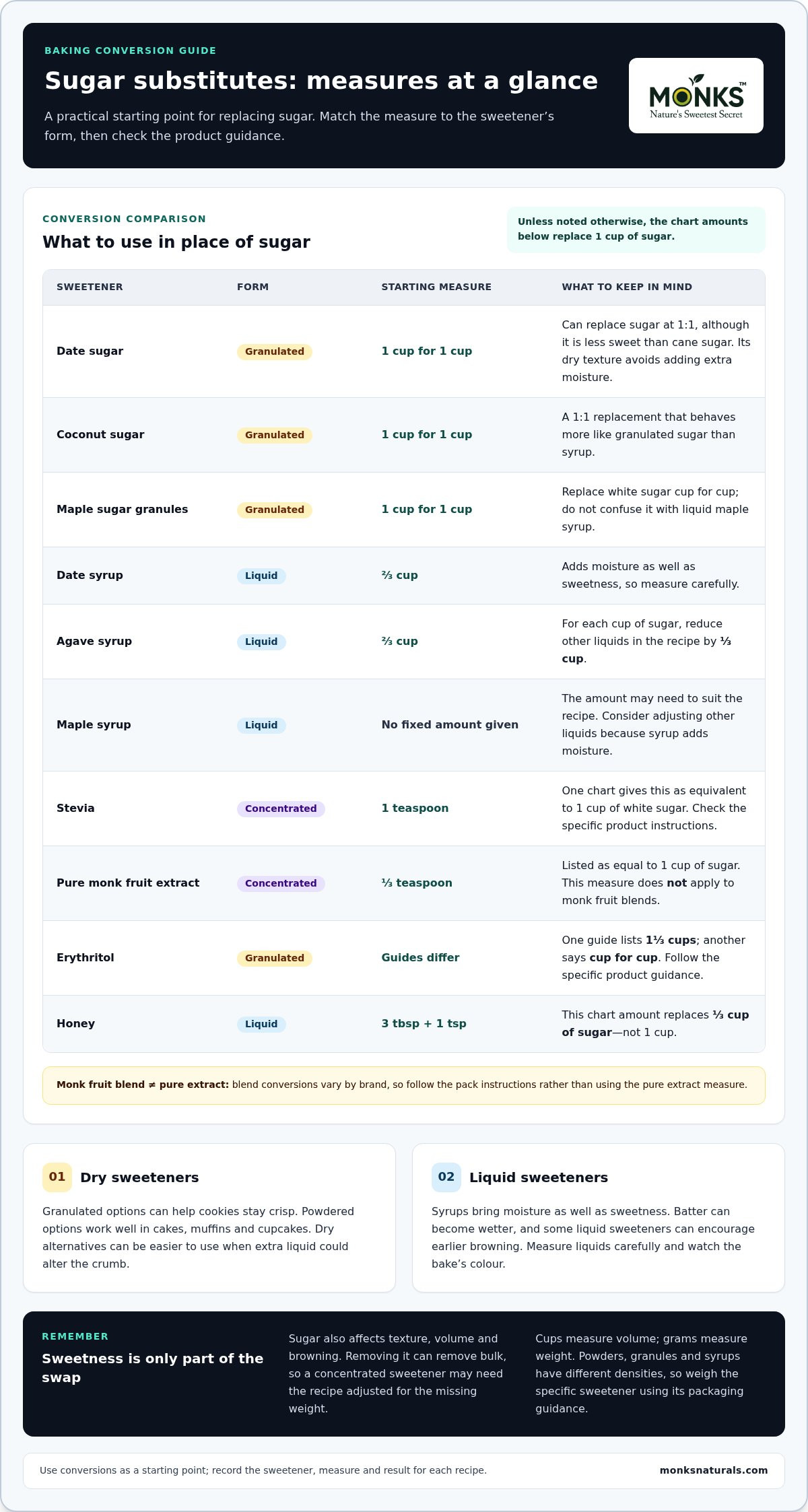
A conversion chart gives you a starting measure for replacing sugar in a recipe. Use the amounts below for a recipe that calls for one cup of sugar, unless an entry says otherwise.
- Maple syrup is a liquid sweetener made from maple sap. Maple syrup is a liquid sweetener, so consider adjusting other liquids in the recipe.
- Date syrup is a liquid sweetener made from dates. Use ⅔ cup in place of one cup of sugar.
- Honey is a sweet, pourable ingredient used in baking. For ⅓ cup of sugar, use 3 tablespoons plus 1 teaspoon of honey.
- Stevia is a concentrated sweetener available in different forms. One chart gives 1 teaspoon as the equivalent of one cup of white sugar, but check the specific product’s instructions.
- Pure monk fruit extract is a concentrated sweetener derived from monk fruit. The chart lists ⅓ teaspoon as equal to one cup of sugar; don’t apply this measure to a blend.
- Maple sugar granules are a dry, granulated sweetener. Replace white sugar cup for cup.
- Erythritol is a sugar alcohol used as a granulated substitute. Conversion guides differ: one lists 1⅓ cups per cup of sugar, whilst another says cup for cup. Follow the specific product’s guidance rather than treating the measures as interchangeable.
Print or save this sugar-free baking conversion chart alongside your recipes, and keep each entry with the sweetener it refers to. The same volume can produce a different level of sweetness or moisture when the ingredient changes. For example, a liquid measure of maple syrup isn’t a direct volume match for granulated maple sugar.
Glycaemic response describes how a food affects blood sugar levels. A conversion amount compares sweetness or recipe use; it doesn’t establish how a sweetener affects an individual’s blood sugar. Organic describes how an ingredient is produced, not how much a recipe needs. Check packaging for ingredient and product details, rather than using either term to predict a baking conversion.
For a reliable bake, note the sweetener, measure and result each time you test a recipe. Record whether the crumb felt moist, the crust browned as expected, and the flavour suited your favourite cake or biscuit. Those observations help refine the next batch without changing several ingredients at once. For another reference point, compare monk fruit sweetener information with the conversion guidance on your own product’s packaging.
Sugar alternatives for baking
A sugar alternative replaces some or all of the sweetness in a recipe. The right choice depends on whether it is granulated, powdered or liquid, because each form affects moisture and volume. Use a sugar free baking conversion chart as a starting point, then adjust for the sweetener’s form.
Refined sugar is sugar processed into familiar forms such as white sugar. Coconut sugar can replace it at a 1:1 ratio, and maple sugar granules can replace white sugar cup for cup. Both are dry, granulated options, so they don’t add syrup’s extra moisture. Date sugar also substitutes at 1:1, although it is less sweet than cane sugar.
Maple syrup is a liquid sweetener used to replace granulated sugar. Use ⅔ cup for each cup of white sugar, then reduce other liquid ingredients by about three tablespoons. Agave syrup is a liquid sweetener, so adjust the other liquids in the recipe when using it. Lower the oven temperature by 25°F when using agave to help prevent over-browning.
Honey is a liquid sweetener that is about 1.5 times sweeter than white sugar. Use ¾ cup for each cup of sugar, reduce other liquids, and lower the oven temperature by 25 degrees. A ¼ teaspoon of baking soda can help balance acidity. For a smaller bake, replace ¼ cup of sugar with 3 tablespoons of honey.
Stevia is a concentrated sweetener that is described as 300 times sweeter than sugar. A small quantity can provide sweetness, but it doesn’t replace the bulk or weight of removed sugar. Adjust the recipe to make up that weight, rather than adding extra stevia. Check the product’s directions because forms and concentrations differ.
Monk fruit extract is a concentrated sweetener whose mogroside compounds are described as 100-250 times sweeter than sugar. Don’t assume a tiny quantity of pure extract matches a monk fruit blend. Blends can contain other ingredients, so follow the pack’s conversion guidance. A powder also measures and behaves differently from liquid drops.
Erythritol is a sugar alcohol used as a granulated sugar substitute. One guide describes it as about 70% as sweet as table sugar, so a cup-for-cup swap may taste less sweet. Allulose is another sugar alternative, described as 70% as sweet as white sugar. Xylitol is as sweet as white sugar, but it can be fatal to dogs if accidentally ingested.
Test one change at a time. For example, replace sugar with coconut sugar in a muffin recipe before adjusting the flour or liquid. Note the sweetener, amount and result. These notes help you decide whether the next batch needs more sweetness, less moisture or a different form.
Sugar measures in teaspoons, tablespoons and cups
Teaspoons, tablespoons and cups are volume measures used in baking. Keep the recipe’s unit in view as you measure: a spoonful of concentrated sweetener cannot be swapped directly for a cup of sugar. In a small batch, even a teaspoon can noticeably change the sweetness.
A granulated measure is a volume of dry crystals or powder. Spoon the ingredient into the measuring cup, then level the top for a consistent amount. Don’t pack it down unless the recipe instructs you to. A packed measure contains more sweetener than a loose one, changing how much goes into the mixture.
A liquid measure is a volume of pourable sweetener, such as honey or maple syrup. Use the recipe’s cup or spoon measure, and reduce other liquids when the conversion calls for it. For each cup of agave syrup used, reduce other liquids by ⅓ cup. This accounts for moisture added by the syrup.
A combination measure uses more than one unit to make a precise amount. For example, replace ⅓ cup of sugar with 3 tablespoons and 1 teaspoon of honey. Read both parts before measuring, then combine them in the same bowl. This example shows why rounding a spoon measure can change the intended conversion.
For another small quantity, ¼ cup of sugar can be replaced with 3 tablespoons of honey. A mug cake calling for 2 tablespoons of sugar uses 4 to 5 teaspoons of honey instead. These examples use different recipes and ratios, so don’t transfer one conversion to another simply because both use spoons.
Concentrated sweeteners need especially careful measuring. One chart gives 1 teaspoon of stevia as the replacement for 1 cup of white sugar, whilst pure monk fruit extract is listed at ⅓ teaspoon for the same sugar amount. Those measures describe different sweeteners; they are not a general teaspoon-to-cup rule.
Before mixing, write down the original amount and its replacement. Check whether the ingredient is liquid, granulated or powdered, and whether the conversion changes other liquids. For a recipe using ½ cup of sugar, one honey conversion uses ⅓ cup of honey, ¼ teaspoon of baking soda and 1 tablespoon less potential liquid. Measuring each component separately makes that combination easier to follow.
When using liquid sweeteners, especially honey, the guide recommends adding ¼ teaspoon of baking soda to balance acidity. For a small baked recipe, use slightly more than ¾ as much honey as sugar, or reduce the sweetener by 1 to 2 teaspoons. For a mug or glass of a sweetened drink, reduce the sweetener by 1/2 to 1 teaspoon for a less sweet taste.
Sugar’s role in baking structure and browning
Sugar’s baking role includes adding sweetness, creating texture and encouraging browning. Sugar also adds bulk, so replacing it with a highly concentrated substitute can leave a recipe short of dry ingredients.
To adjust a recipe, first identify whether the substitute is dry and granulated or liquid. For liquid sweeteners, reduce other liquids by about ¼ cup as a starting point, then follow that sweetener’s specific conversion. Keep dry ingredients steady at first, changing one element at a time.
Creaming means beating sugar with butter to incorporate air. Granulated crystals help create small air pockets, supporting a lighter texture in cakes and biscuits. Fine powder may dissolve differently, while syrup won’t do the same job in the same way. For a cake, check whether the method starts by creaming butter and sugar before choosing a substitute.
Browning is the surface colour that develops as a bake cooks. Honey can brown a loaf before its centre is fully cooked, so lower the oven temperature about halfway to three-quarters through baking. Watch the crust and centre rather than relying on colour alone. Liquid sweeteners also add moisture, which can affect how quickly a bake sets.
Bulk is the volume and weight an ingredient contributes beyond its sweetness. Stevia is described as 300 times sweeter than sugar, so using less sweetener removes more of sugar’s physical presence. Adjust the recipe to make up the weight of sugar left out. Don’t compensate by adding extra flour automatically; first consider what the recipe’s other ingredients already contribute.
Coconut sugar is a granulated alternative that can replace sugar at a 1:1 ratio. It keeps the recipe’s measured volume similar, but the bake’s colour and flavour may differ. Allulose is a sweetener described as 70% as sweet as white sugar. Its sweetness level means a direct volume swap may not deliver the same taste.
Glucose is a simple sugar found in many foods and used by the body for energy. In baking, the type and amount of sweetener influence how a recipe behaves, so matching sweetness alone won’t guarantee the same structure. A conversion chart is a starting point, not a promise of identical crumb or crust.
If you track blood sugar, remember that a baking conversion helps measure recipe ingredients only. It doesn’t tell you how a finished bake will affect your individual blood sugar levels. For a useful comparison, record the substitute, liquid adjustment and oven changes, then assess the next batch’s rise, centre and browning.
MONKS: Monkfruit decoction with soluble tapioca fibre Powder
Monkfruit decoction with soluble tapioca fibre Powder is a spoonable monk fruit option for home baking. Try it in cookies, cakes or muffins, bearing in mind that conversions vary between products. Follow the pack guidance and adjust the recipe to suit its texture and sweetness.
MONKS makes its sweetener from whole fruit decoction, produced by gently simmering monk fruit. The powder contains soluble tapioca fibre and is free from erythritol, maltodextrin and fillers. If a liquid format suits your recipe better, Monkfruit decoction Drops are another option. The MONKS Set brings together the brand’s products.
Explore the MONKS monk fruit sweeteners and choose a format for your next bake.
Make your next bake your own
Treat your next batch as a small kitchen experiment. Choose one recipe, make one sweetener adjustment and note the results. Use a sugar free baking conversion chart to choose a starting measure, then record what works for your preferences.
If you’d like to explore monk fruit, MONKS offers Monkfruit decoction with soluble tapioca fibre Powder, Monkfruit decoction Drops and The Monks Set. A sugar free baking conversion chart can guide your starting measure, while your notes help you adapt the recipe to the format you choose.
Contact MONKS about your baking plans and explore a new way to sweeten your kitchen favourites. Each thoughtful adjustment brings you closer to a recipe that feels right for your table.
Frequently Asked Questions
What are the best sugar substitutes for baking?
The best substitute depends on the bake’s texture and how much moisture the recipe can take. For crisp biscuits, try a dry, granulated option; for a soft cake, choose a form that mixes smoothly into the batter. In brownies, flavour and a moist crumb matter. Start with a small test batch, changing only the sweetener so you can judge its effect.
What is the sugar-to-sweetener conversion ratio for popular sugar-free baking sweeteners?
Ratios vary: coconut sugar and maple sugar granules can replace sugar 1:1, whilst maple syrup uses ⅔ cup per cup of sugar. A sugar-free baking conversion chart is a starting reference, not a universal rule. Pure monk fruit extract and monk fruit blends need different measures, so use the instructions for the exact product. For syrups, account for added liquid as well as sweetness.
Do sugar-free sweeteners affect baking texture, browning and moisture?
Yes. A sweetener can change a bake’s moisture, colour and crumb because it may add liquid or provide less bulk than sugar. If a trial cake sinks or feels damp, consider whether the substitute added moisture and whether the centre baked through. If biscuits spread or brown too quickly, note the sweetener and oven result before adjusting the next batch. Keep the other ingredients constant while testing.
Which sugar substitutes work best for cakes, biscuits, brownies and meringues?
For cakes, choose a sweetener that mixes evenly through the batter; for biscuits, a granulated option can help preserve a crisp texture. For brownies, assess both flavour and crumb in a test bake to find a suitable option for their dense, moist finish. Meringues rely on sugar for structure, so direct substitution is less straightforward. Don’t assume a sweetener will behave the same way in all four bakes.
Can I use sweetener blends in a sugar-free baking conversion chart?
Yes, but treat each blend as its own ingredient because its sweetness and bulk depend on its formulation. Follow the blend’s stated conversion rather than copying a ratio for pure stevia or monk fruit extract. If the recipe allows, test a small portion first and record the measure, texture and flavour. Combining sweeteners may help balance aftertaste, but blends aren’t interchangeable.


