

What if a sweet taste doesn’t automatically mean food for the bacteria linked to tooth decay? If you’re asking, “does monk fruit cause tooth decay?”, the answer depends on more than how sweet it tastes. The other ingredients in the product matter too.
It’s understandable to be cautious. Sweeteners can look similar on the shelf, yet their formulations differ. Available evidence suggests monk fruit’s mogrosides aren’t fermented by oral bacteria in the same way as sugar. But a product labelled “monk fruit” may contain other ingredients, so check the full label.
This guide explains how decay develops, what the evidence says about monk fruit, and how to assess a product’s ingredients. It also covers how frequency of exposure and oral-care habits fit into the picture. No sweetener is a substitute for good dental care.
MONKS offers monk fruit decoction drops and a powder made with soluble tapioca fibre. They are different formulations, so assess each product by its ingredients rather than assuming it has a particular dental effect.
Key Takeaways
- Does monk fruit cause tooth decay? Sweetness alone can’t answer that; the full formulation and how often you consume it matter.
- Plaque bacteria can use fermentable carbohydrates and produce acid, and repeated acid exposure can affect enamel over time.
- Read the ingredient list, not just the front label, to distinguish monk fruit ingredients from blends and spoonable powders.
- Check ingredients, be mindful of frequency and follow current UK guidance on brushing and fluoride.
- MONKS monk fruit decoction drops and powder with soluble tapioca fibre have different formulations. Neither should be assumed to prevent cavities.
Does monk fruit cause tooth decay? Start with the short answer
Sweetness alone doesn’t tell you whether a product contributes to tooth decay. The ingredients, how often you consume it and your oral-health context all matter. So, does monk fruit cause tooth decay? Available evidence suggests the sweet compounds in monk fruit, called mogrosides, aren’t fermented by oral bacteria in the way sugars are. That doesn’t make every product containing monk fruit risk-free or protective.
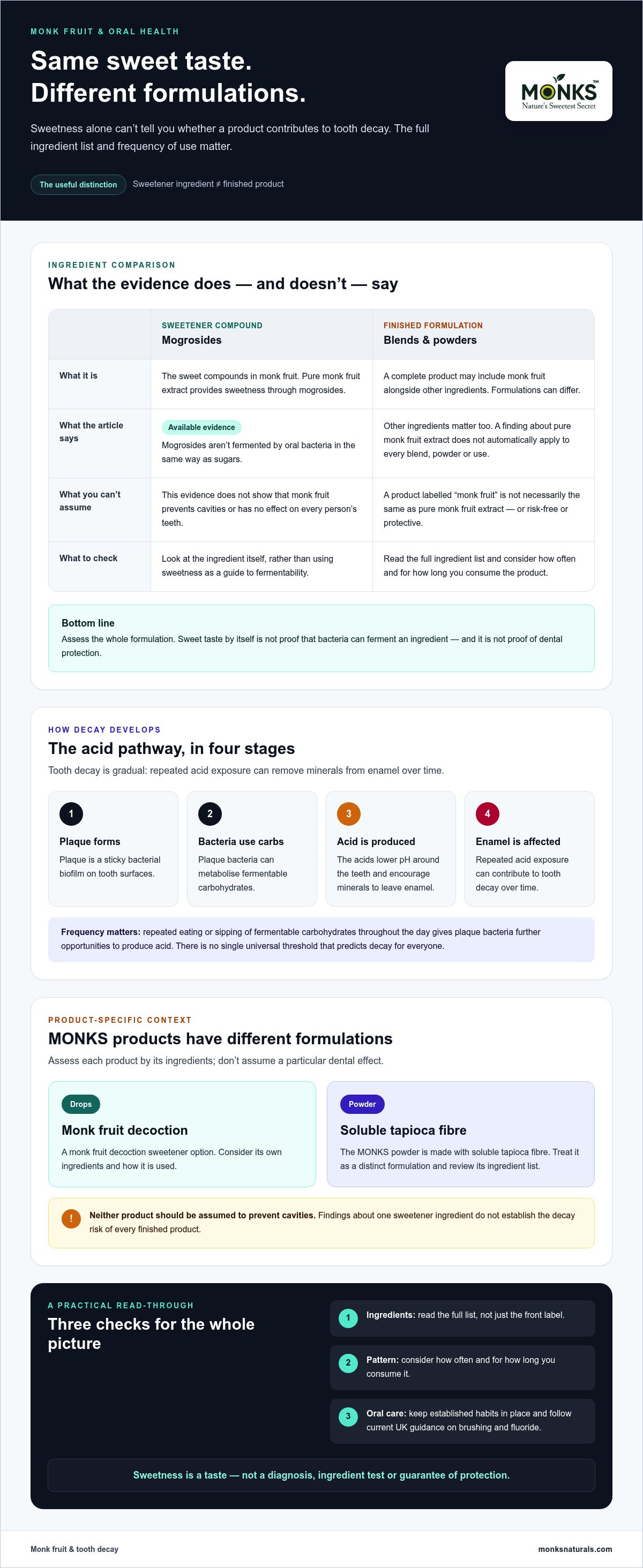
Tooth decay develops when plaque bacteria metabolise fermentable carbohydrates and produce acids. Repeated acid exposure can cause minerals to leave the enamel over time. The overview of How Tooth Decay Develops explains this process. A sweet taste is a sensory experience, not proof that a food contains carbohydrates bacteria can ferment.
It also helps to distinguish decay from other sensations. A sweet flavour, an unusual aftertaste or brief sensitivity doesn’t by itself show that decay is occurring. Tooth decay can’t be diagnosed from taste alone. If you have persistent sensitivity, pain or another concern, seek advice from a dental professional.
Why sweetness alone doesn’t answer the question
Sweetness and fermentable carbohydrate aren’t interchangeable. Pure monk fruit extract provides sweetness through mogrosides, which available evidence suggests aren’t fermented by oral bacteria. This relates to the sweetener compounds, not to every product containing them. It isn’t a promise that monk fruit prevents cavities or has no effect on every person’s teeth.
The finished product is a separate consideration. A blend or powder may contain other ingredients alongside monk fruit, and their relevance depends on what they are and how the product is used. Don’t assume every product labelled “monk fruit” has the same formulation or behaves identically in the mouth.
What readers should take from the evidence
The useful distinction is between an individual sweetener ingredient and the complete formulation. Current evidence points to mogrosides not being fermented like sugar, but that finding alone can’t establish the decay risk of every product or account for someone’s eating pattern and oral health.
For a product-specific view, read the whole ingredient list rather than relying on front-of-pack wording. Identify the other ingredients and consider how frequently and for how long you consume the product. Ingredient order can offer context, but it doesn’t replace reliable evidence about a specific ingredient’s role in decay.
A finding about pure monk fruit extract isn’t automatically a finding about blends, powders or every way of using them. Likewise, a non-sugary taste doesn’t establish dental protection. Assess the formulation alongside your routine, and keep established oral-care habits in place. To put the ingredients in context, it helps to understand how plaque, fermentable carbohydrates and repeated acid exposure affect teeth.
How tooth decay develops: plaque, fermentable carbohydrates and acid
Tooth decay is damage to the hard surface of a tooth caused by acids that remove minerals from enamel over time. It’s a gradual process, not an instant reaction to a sweet taste. Plaque, the carbohydrates in foods and drinks, how often teeth are exposed, saliva and oral hygiene all help shape what happens.
Understanding this process puts sweeteners into context. The question isn’t simply whether something tastes sweet, but whether its ingredients can be used by mouth bacteria to produce acid and how often that exposure occurs. The Dental Health Foundation’s guide to artificial sweeteners and oral health offers further context on sweeteners and teeth.
What plaque bacteria do after eating
Plaque is a sticky bacterial biofilm that forms on tooth surfaces. When bacteria in plaque metabolise fermentable carbohydrates, they can release acids. These acids lower the pH around the teeth and encourage minerals to leave the enamel. Different foods and ingredients don’t behave identically, so a sweet taste alone doesn’t establish that this acid-producing process will occur.
Enamel can regain some minerals between acid exposures, helped by saliva. Saliva also helps clear food residue and neutralise acids. Brushing and cleaning between the teeth help remove plaque, though established cavities need professional dental care rather than a change of sweetener alone.
Why frequency and context matter
The pattern of exposure matters alongside the amount consumed. Repeatedly eating or sipping fermentable carbohydrates throughout the day can give plaque bacteria further opportunities to produce acid. There isn’t one universal threshold that predicts decay for everyone. Saliva, existing oral-health conditions, hygiene habits and the wider diet all affect individual risk.
That’s why a single ingredient can’t tell the whole story. Monk fruit decoction is a sweetener ingredient, whilst a finished powder or blend may include other components. To see the MONKS options, explore MONKS monk fruit decoction options and assess each product by its ingredients. The products have distinct formulations, so don’t assume findings about one ingredient apply to every product or use.
In practice, look at the whole pattern: what the product contains, how often you use it and how it fits around meals and oral care. That gives a more useful picture than sweetness alone. It also explains why the next step is to compare monk fruit ingredients with other components that may appear in powders and blends.
Monk fruit, blends and powder: why the full ingredient list matters
A front label can tell you what gives a product its headline flavour, but not necessarily everything in the spoon or dropper. “Monk fruit” might describe a sweetener ingredient in a simple formulation, or feature in a product with other ingredients added for sweetness, texture or volume. These formats aren’t interchangeable. Assess the actual ingredient list instead of assuming all monk fruit products are alike.
Pure monk fruit and blended sweeteners are not the same
A product made with monk fruit alone differs from a blend that combines monk fruit with bulking agents or other sweeteners. Some ingredients, such as dextrose or maltodextrin, are fermentable carbohydrates and may contribute to acid production. Other bulking agents have different properties. Don’t transfer conclusions about one ingredient, or one brand’s blend, to every product in the category.
Powders also vary. A spoonable product may include a carrier or fibre to give it bulk, whilst drops are a different format. The word “powder” doesn’t tell you what that ingredient is or how it affects the overall formulation. Read the label for the particular product you use.
What to check on a monk fruit product label
Start with the full ingredient list, not just claims on the front. Ingredient order can offer a clue to how a product is formulated, but it isn’t a substitute for identifying each ingredient. Look for bulking agents, added sweeteners and other carbohydrates. If a term is unfamiliar, look it up using a reliable source before drawing conclusions about its dental relevance.
| Product type | Possible formulation | What to check |
|---|---|---|
| Monk fruit ingredient | Monk fruit as the sweetening ingredient | Whether the ingredient list includes anything else |
| Blended sweetener | Monk fruit alongside bulking agents or other sweeteners | Each added ingredient, including any fermentable carbohydrates |
| Spoonable powder | Monk fruit with a carrier or fibre, depending on the product | The named carrier and the complete formulation |
MONKS’ powder combines monk fruit decoction with soluble tapioca fibre. Its drops are a separate offering. MONKS products are free from erythritol, maltodextrin and artificial fillers. These are formulation details, not evidence that a product prevents decay or protects teeth. Nor should the properties of one type of fibre be assumed to apply to all fibres or formulations.
For a product-specific example, assess the MONKS monk fruit sweetener powder in the same way: read every listed ingredient and consider the formulation as a whole. That’s a more grounded way to answer “does monk fruit cause tooth decay?” than relying on a broad front-label claim.
Practical ways to enjoy sweeteners while caring for your teeth
A thoughtful sweetener choice can sit alongside good oral care, but it can’t replace it. Read the label, notice how often you have sweetened foods and drinks, and keep up established dental habits. No sweetener choice can guarantee that tooth decay won’t develop.
How to make an informed everyday choice
Look at the ingredients in the products you actually use. A sweetener in tea, a snack and a recipe may have different formulations, so check each label instead of relying on a general category name. Pay attention to added ingredients and consider how often you’re eating or sipping throughout the day.
There’s no single intake limit that can be recommended for everyone on the basis of this article. Your overall diet, oral health and individual circumstances matter. Use ingredient information to make a considered choice, and don’t treat a “tooth-friendly” front-label impression as a substitute for reviewing the full formulation.
Keep established oral care in your routine
Follow current UK dental-health guidance: brush twice a day with fluoride toothpaste, including last thing before bed, and spit rather than rinsing straight away. Use age-appropriate toothpaste and follow its instructions. Regular dental appointments also help maintain your care routine and give you a chance to raise questions about your teeth.
- Check the ingredients. Read the full list on the sweetener, drink, snack or recipe product you’re using. Formulations can differ, even when the front label uses similar wording.
- Notice frequency. Consider how often sweetened foods and drinks feature across your day. You don’t need to set an arbitrary personal limit; simply be aware of repeated eating and drinking occasions.
- Keep up oral care. Brush with fluoride toothpaste as recommended, and continue regular dental care. A sweetener choice isn’t a replacement for either.
In short, check the formulation, be mindful of repeated exposures and maintain your usual oral-care routine. These steps support informed choices, but they can’t diagnose, treat or guarantee prevention of decay. Choosing monk fruit, or any other sweetener, isn’t a substitute for individual dental advice.
When to seek personalised dental advice
If you have ongoing pain, sensitivity or concerns about your teeth, speak with a dentist rather than trying to diagnose the cause through a sweetener change. A dentist can assess your individual situation. If you have dietary or medical concerns affecting your choices, ask an appropriate health professional for advice suited to you.
If you’re comparing monk fruit options as part of your ingredient check, explore MONKS monk fruit decoction products and review each formulation. Use the same careful approach you would with any sweetener, alongside, not instead of, your regular dental care.
Choosing MONKS monk fruit products with a clear understanding
Once you know that a product’s full formulation matters, choosing a sweetener can be a simple kitchen decision. MONKS offers monk fruit decoction in two formats: a powder made with soluble tapioca fibre and liquid drops. Neither should be viewed as a way to prevent tooth decay. Compare the ingredients and choose the format that suits how you like to sweeten food or drinks.
Powder or drops: choose by how you use it
A powder may suit a routine where you prefer a spoonable format, while drops offer a liquid alternative. They are separate products, not interchangeable formulations. Consider how you plan to use a sweetener in everyday cooking or drinks, then review the ingredient information for that specific format. Don’t assume that the ingredients or dental effects of one format apply to the other.
The MONKS powder combines monk fruit decoction with soluble tapioca fibre. The drops are a separate monk fruit decoction offering. A carrier or additional ingredient can be part of a product’s formulation, so read the full label instead of making a decision from the words “monk fruit” alone. This is an ingredient check, not a prediction of what will happen to your teeth.
Read the formulation, not just the front label
MONKS products are free from erythritol, maltodextrin and artificial fillers. These are product formulation details, not evidence that either format prevents cavities, protects enamel or improves dental health. The presence of soluble tapioca fibre in the powder shouldn’t be taken as proof of a dental effect, and its properties shouldn’t be generalised to every fibre or sweetener product.
So, does monk fruit cause tooth decay? Sweetness alone doesn’t settle the question. The full ingredient list, how often a product is used and your broader oral-health context all belong in the picture. Keep established dental care in place, and seek personalised advice from a dentist if you have ongoing pain, sensitivity or concerns. A sweetener is a food choice, not a treatment or a replacement for dental guidance.
A practical way to decide is to match the format to your everyday routine, then check the ingredients for that exact product. If you prefer a spoonable option, note that the powder combines monk fruit decoction and soluble tapioca fibre. If drops better suit your habits, review their product information separately. This keeps the choice practical and avoids assuming that one format is automatically better for teeth.
For a closer look at the available formats and their ingredient information, explore MONKS monk fruit products. Choose based on the formulation and how you plan to use it, without expecting a dental-health outcome from the sweetener itself.
Make your next sweetener choice with confidence
Take a small, informed step: choose the format that fits your everyday routine, then review its ingredients. The question “does monk fruit cause tooth decay” isn’t answered by sweetness alone, and no sweetener can replace consistent oral care or advice tailored to your teeth.
MONKS offers monk fruit decoction powder with soluble tapioca fibre and separate liquid drops. Its products are free from erythritol, maltodextrin and artificial fillers. These are formulation details, not promises about dental outcomes. Use the ingredient information to decide what suits your preferences, and keep your usual dental-care habits in place.
Explore monk fruit sweetener options and find a format that feels at home in your kitchen. Choose with the formulation and your intended use in mind.
Frequently Asked Questions
Does monk fruit cause cavities?
Not necessarily. The answer to “does monk fruit cause tooth decay” depends on the product, not just its sweet taste. For example, check whether a sachet or baking blend includes other ingredients alongside monk fruit. A front-label claim can’t tell you the full formulation. Compare the ingredient list for the exact product, and keep your usual dental-care routine rather than relying on a sweetener choice alone.
Is monk fruit sweetener better for your teeth than sugar?
There isn’t a blanket answer for every monk fruit product. A product’s other ingredients and your overall routine matter, so compare the labels of the specific products you use. A liquid sweetener and a spoonable baking product, for example, may have different formulations. Don’t interpret “better for your teeth” as a guarantee: continue brushing with fluoride toothpaste and seek professional advice for concerns about your own dental health.
Can monk fruit sweetener damage tooth enamel?
A sweet flavour alone doesn’t show that a product has damaged enamel. Tooth decay can involve plaque and acid exposure, but sensitivity or discomfort can have different causes and can’t be diagnosed from taste. Notice whether symptoms persist or occur in particular situations, such as with hot or cold drinks, and discuss them with a dentist. Don’t try to treat a dental problem by switching sweeteners without getting appropriate advice.
Does monk fruit powder contain ingredients that affect teeth?
That depends on the powder’s formulation, so read the complete label rather than stopping at “monk fruit”. MONKS describes its powder as monk fruit decoction with soluble tapioca fibre. That ingredient description alone doesn’t establish a dental benefit or risk. If you use powder in baking, check the product label and recipe ingredients separately, since a finished recipe may contain other components beyond the sweetener.
Does the frequency of sweet foods matter for tooth decay?
It can be useful to notice how often fermentable carbohydrates appear across your day, rather than focusing only on one serving. For example, consider whether sweetened drinks are sipped repeatedly between meals or whether sweet foods are eaten on separate occasions. Individual circumstances vary, so don’t use a universal number as a personal rule without current dental guidance. Keep daily oral care consistent, whatever sweetener you choose.
Should I stop using monk fruit if I am worried about cavities?
Not automatically. Start by checking the ingredients in the particular product and considering your wider routine, including dental care. A sweetener can’t identify or treat a cavity. If you’ve had decay before, have persistent sensitivity or feel unsure about what suits your circumstances, speak with your dentist. They can give advice based on your teeth and history, rather than a general rule about every monk fruit product.


