

The "natural" label on your favourite snack often hides a lab-made reality. Whilst many reach for artificial options to avoid calories, the hidden cost to your digestive comfort can be high. If you've ever experienced the bloating, the metallic aftertaste, or the confusion of chemical processing, you aren't alone. Choosing between monk fruit vs sucralose is about more than just sweetness; it's about how your body reacts to what you consume. We believe your daily tea or morning bake should be simple, clean, and kind to your system.
You deserve a sweetener that offers stable blood sugar, a happy gut, and genuine flavour. This article clarifies the critical differences between a traditional fruit decoction and synthetic alternatives like sucralose. We will explore the origins, the health impacts, and the culinary performance of both options. You'll discover which sweetener provides the purity your wellness routine deserves and how to integrate better choices without the complexity. We compare the science, the safety, and the taste to help you find the right balance for your kitchen and your health.
Key Takeaways
- Contrast the traditional simmering of whole fruit with the industrial, multi-step, chemical synthesis used to create sucralose.
- Understand the impact of monk fruit vs sucralose on your microbiome to avoid bloating, gas, and digestive discomfort.
- Learn how to bake, brew, and sweeten your favourite recipes with a rounded depth that avoids metallic aftertastes.
- Identify the importance of clean labels that are free from erythritol, maltodextrin, and artificial fillers.
Understanding the Basics: Natural Fruit vs Lab-Altered Molecules
Choosing between monk fruit vs sucralose often feels like a simple choice between two calorie-free paths. However, their biological origins couldn't be more different. One is a small fruit grown in high-altitude orchards; the other is a molecule reconstructed in an industrial facility. For the modern, health-conscious kitchen, understanding this distinction is the first step toward a cleaner lifestyle. It's the difference between a botanical essence and a chemical construction.
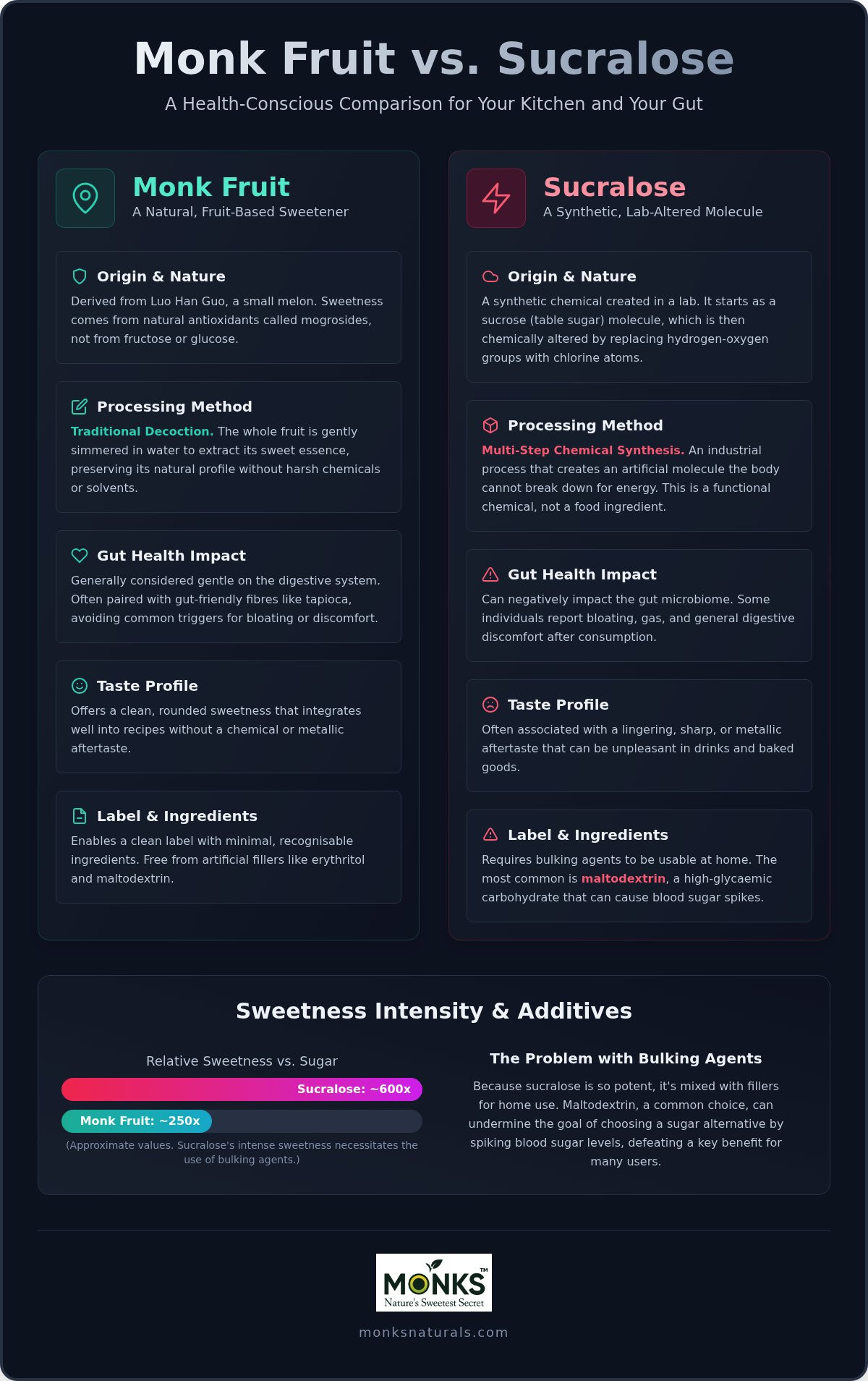
Monk fruit, or Luo Han Guo, is a small melon-like fruit. Its intense sweetness doesn't come from natural sugars like glucose or fructose. Instead, it contains unique antioxidants called mogrosides. When we look at sugar substitutes, monk fruit stands out because it provides sweetness without the metabolic impact of traditional sugar. In contrast, sucralose is a synthetic creation. It starts as sucrose, but chemists replace specific atoms with chlorine to ensure the body cannot break it down for energy.
What is Monk Fruit Decoction?
A decoction is a gentle, water-based simmering method used for centuries to extract the essence of plants. At MONKS, we honour this tradition by simmering the whole fruit to create a liquid that retains its natural character. This is fundamentally different from the highly processed, lab-isolated extracts found in many supermarket aisles. Our process ensures a clean label that respects the fruit's integrity. We avoid the harsh solvents often used in industrial extraction, focusing instead on three pillars:
- Purity through traditional simmering
- Retention of natural mogrosides
- Zero chemical residues or fillers
The Chemistry of Sucralose
Sucralose is manufactured through a multi-step chemical synthesis. By chlorinating sucrose, scientists create a molecule that is roughly 600 times sweeter than sugar. Whilst it tastes sweet on the tongue, your digestive system doesn't recognise it as a carbohydrate. It passes through the body largely unchanged. In the UK, you'll most commonly find sucralose under brand names like Splenda or as a primary ingredient in "diet" fizzy drinks and "light" yoghurts. Because it is a lab-altered molecule, it lacks the wholesome, botanical history of fruit-derived alternatives. It's a functional chemical rather than a food ingredient.
Processing Methods: Whole Fruit Decoction vs Chemical Synthesis
The way a sweetener is made dictates its purity and how your body receives it. When comparing monk fruit vs sucralose, the gap between a culinary tradition and an industrial synthesis becomes clear. One method relies on water and patience; the other depends on chemical reactors and molecular modification. These paths result in two very different experiences for your palate and your health.
Health organisations often group these products together as Low-Calorie Sweeteners, but their manufacturing paths couldn't be more distinct. We believe in transparency. By looking at the journey from source to spoon, you can make an informed choice for your home.
The Traditional Simmering Advantage
We treat monk fruit like a whole food. By simmering the fruit in water, we extract its sweetness without destroying its natural profile. This gentle decoction approach avoids the harsh solvents and chemical bleaching often found in mass-produced, lab-isolated extracts. It results in a clean, rounded flavour that lacks the sharp "chemical" bite associated with synthetic alternatives. For those following a "whole food" lifestyle, this purity is essential. You can explore the history of this process in Monk Fruit Decoction: The Traditional Guide.
Why Sucralose Requires Bulking Agents
Sucralose is intensely sweet. It's roughly 600 times sweeter than table sugar. This poses a practical problem for your kitchen; you can't easily measure a microscopic speck for your morning coffee. To make it "spoonable," manufacturers add bulking agents. Most supermarket brands use maltodextrin. This filler is a high-glycaemic carbohydrate that can cause blood sugar spikes, which often defeats the purpose of choosing a sugar alternative. The debate over monk fruit vs sucralose often overlooks these hidden additives.
We take a different route. Our powder uses soluble tapioca fibre instead of maltodextrin or other artificial fillers. It's a gut-friendly choice that provides the right texture without the metabolic cost. If you want to simplify your pantry with ingredients you recognise, you might find our traditional decoctions are the missing piece of your wellness routine.
The Gut Health Debate: Microbiome Impact and Digestion
Your gut is the centre of your wellness. What you consume either nourishes your internal ecosystem or disrupts it. When looking at monk fruit vs sucralose, the impact on your microbiome is perhaps the most significant health factor to consider. Many people switch to sweeteners to improve their health, only to find themselves dealing with unexpected bloating and digestive upset.
Sucralose and the Microbiome
Sucralose is a synthetic molecule. Because the body doesn't recognise it as food, it travels through your digestive tract largely intact. Recent research suggests this journey isn't as harmless as once thought. Studies indicate that sucralose can reduce the diversity of beneficial gut flora, potentially leading to an imbalance known as dysbiosis. A 2022 study in Cell found sucralose can alter glucose tolerance by changing the microbiome. For sensitive individuals, this disruption often manifests as:
- Persistent bloating after meals
- Increased intestinal permeability
- Subtle inflammatory responses
It's a frustrating cycle. You choose a "light" product to feel better, yet your digestive system feels worse. This chemical interaction is why many wellness-seekers are moving away from chlorinated sweeteners in favour of botanical options. It's time to prioritise your internal balance.
Monk Fruit and Prebiotic Fibre
Monk fruit offers a different path. As a non-nutritive sweetener derived from fruit, it's generally recognised as gut-friendly. It doesn't feed harmful bacteria or trigger the same inflammatory pathways as synthetic alternatives. However, the sweetener you choose is only as good as its fillers. Many monk fruit blends on the market use erythritol. This sugar alcohol is notorious for causing gas and digestive distress in even small amounts.
We choose a cleaner approach. Our powder is entirely erythritol-free. Instead, we use soluble tapioca fibre. This ingredient serves a dual purpose. It provides the "spoonable" texture you need for baking whilst acting as a prebiotic. It nourishes your beneficial bacteria, supports healthy digestion, and keeps your blood sugar stable. By combining a traditional decoction with gut-friendly fibre, we ensure your sweetness never comes at the cost of your comfort. You can find our clean-label blends at monksnaturals.com to start supporting your microbiome today.
Culinary Performance: Baking, Brewing, and Heat Stability
Sweetening your life shouldn't feel like a science experiment. The choice between monk fruit vs sucralose often comes down to how they behave in your kitchen. Sucralose is an intense, high-octane sweetener. Monk fruit decoction is more rounded and gentle. This difference is most apparent when you turn up the heat or stir them into a delicate brew. One feels like a lab-made additive; the other feels like a kitchen staple.
Both options are stable at high temperatures, but they age differently in the oven. Sucralose can lose its sweetness profile or develop a bitter edge when baked for long periods. Monk fruit decoction is different. It develops a subtle, caramel-like depth that enhances the richness of your biscuits and sponges. Unlike many monk fruit blends that use erythritol, our pure decoction has no "cooling effect". That distracting, minty sensation is absent. You get a clean, sugar-like finish that doesn't interfere with the true flavour of your ingredients.
Sweetening Your Morning Brew
Delicate teas and matcha are sensitive to chemical interference. Sucralose often leaves a "tinny" or artificial aftertaste that masks the subtle notes of high-quality leaves. It's a sharp sweetness that can feel disconnected from the drink. Using Monkfruit decoction Drops provides a seamless finish. It feels like a natural extension of the liquid rather than a separate layer. Because it's a liquid, it dissolves instantly without leaving grit at the bottom of your cup. Start with one or two drops and adjust. You'll find it offers a clean sweetness that respects the complexity of your favourite coffee or tea.
Baking Without the Chemical Aftertaste
For your favourite British bakes, our Monkfruit decoction with soluble tapioca fibre Powder is a simple 1:1 substitute for sugar. This makes converting old family recipes effortless. You don't need complex charts or tiny measuring spoons. Because we use soluble tapioca fibre instead of maltodextrin, your cakes stay moist. Maltodextrin can draw moisture out of the batter, leaving sponges dry and causing them to brown too quickly in the oven. Our blend supports the structure of your bake whilst keeping the crumb tender and light. It's the secret to a perfect sugar-free Victoria sponge or a batch of chewy biscuits.
Ready to transform your kitchen routine with a sweetener that actually performs? Explore our range of traditional decoctions to find the perfect match for your next bake.
Why MONKS Decoction is the Superior Choice for UK Households
The journey to a healthier lifestyle shouldn't require a degree in chemistry. When we weigh up monk fruit vs sucralose, the decision ultimately rests on what you value in your daily ritual. One is a product of nature, refined through time and tradition. The other is a product of industry, designed for function over wellness. Choosing our traditional decoction means prioritising your body's long-term balance over a quick, synthetic fix.
We are the UK leader in monk fruit decoction because we refuse to compromise on purity. Our mission is to provide a clean, transparent alternative that fits seamlessly into your morning routine. By focusing on what we leave out, we've created a product that respects your palate and your health. Our labels are simple, our methods are traditional, and our results are delicious.
The Problem with Generic Supermarket Sweeteners
Walk down any UK supermarket aisle and you'll find "monk fruit" blends that are often misleading. Many of these products contain 99% erythritol, with only a tiny fraction of fruit extract added for marketing. This hidden filler is why so many people experience the "cooling effect" or digestive upset mentioned earlier. We believe in total transparency. Our ingredients list is short, honest, and entirely free from:
- Erythritol and sugar alcohols
- Maltodextrin and artificial fillers
- Chemical solvents and bleaching agents
It's vital to check your labels. If a product feels unusually heavy or looks like white granulated sugar, it's likely bulked with synthetic additives. Our decoction maintains the natural integrity of the fruit, providing a wholesome sweetness that generic brands simply cannot match.
Starting Your Sugar-Free Journey
Transitioning away from artificial sweeteners is a simple act of self-care. It doesn't have to be a complex lifestyle overhaul. Start by swapping your usual sucralose drops for our pure liquid decoction in your tea or coffee. Once you've experienced the clean, sugar-like finish, you can move on to replacing sugar in your weekend bakes with our fibre-enriched powder. It's about making better choices, one cup at a time.
We've mastered this specific niche so you don't have to worry about the details. Whether you're brewing, baking, or brewing, our range offers the versatility you need for a modern, health-forward life. If you're ready to embrace a cleaner way to sweeten your day, you can shop the MONKS range on Amazon UK for fast, reliable delivery to your door. Choose the traditional path to wellness and discover the difference that purity makes.
Embrace a Cleaner Way to Sweeten Your Day
Choosing between monk fruit vs sucralose is about more than just calorie counting. It's a decision to move away from industrial, lab-made molecules in favour of a traditional, whole-food approach. By opting for a natural decoction, you protect your gut microbiome, avoid the discomfort of artificial bloating, and enjoy a rounded sweetness that behaves beautifully in your favourite bakes. You deserve a sweetener that respects your body as much as your palate.
As the UK's leading monk fruit specialist, we focus on what's absent from our products. You won't find erythritol, maltodextrin, or artificial fillers in our range. We use a traditional whole-fruit decoction method to ensure every drop and spoonful feels like a mindful choice for your wellness. It's time to simplify your pantry and trust in the purity of nature. Integrating these better habits into your morning tea or weekend cakes shouldn't feel like a chore.
Switch to a cleaner sweetness with MONKS Naturals and discover how effortless wellness can be. Your journey to a more balanced, sugar-free life starts with a single, simple swap. We're here to guide you toward a brighter, cleaner ritual.
Frequently Asked Questions
Is monk fruit safer than sucralose for long-term use?
Monk fruit is a botanical whole-food extract used for centuries, whilst sucralose is a synthetic molecule created in a lab. Research into monk fruit vs sucralose suggests that the natural antioxidants in the fruit are stable and safe for daily consumption. Sucralose safety is reconfirmed by regulators, but concerns remain regarding its impact on gut health. Choosing a plant-based decoction avoids the heavy chemical processing associated with artificial alternatives.
Does sucralose raise insulin levels like sugar does?
Sucralose itself has zero calories, but some studies suggest it can alter how your body handles glucose. A 2022 study in Cell found that sucralose can change the gut microbiome, which may affect insulin sensitivity over time. Pure monk fruit decoction doesn't trigger an insulin response. This makes it a more reliable choice for those monitoring their metabolic health or comparing monk fruit vs sucralose for blood sugar management.
Why does some monk fruit have a cooling aftertaste whilst others do not?
The "cooling effect" isn't caused by the fruit itself but by the presence of erythritol. Many supermarket blends use this sugar alcohol as a cheap bulking agent. Pure decoctions, like our drops or powder with tapioca fibre, are entirely erythritol-free. They provide a rounded, sugar-like sweetness without that distracting minty sensation. Always check the label for hidden sugar alcohols if you want to avoid this artificial aftertaste.
Can I use monk fruit powder in a 1:1 ratio for baking?
Yes, our Monkfruit decoction with soluble tapioca fibre Powder is designed for 1:1 sugar replacement. This makes it simple to adapt your favourite British recipes without complex conversions. Unlike pure sucralose, which is 600 times sweeter than sugar and lacks bulk, our spoonable powder provides the necessary texture for biscuits and cakes. It ensures your bakes maintain their structure whilst staying light, moist, and delicious.
Is sucralose considered a "natural" sweetener because it comes from sugar?
No, sucralose is classified as an artificial sweetener. Whilst it starts as a sucrose molecule, the manufacturing process involves replacing specific groups with chlorine atoms. This chemical modification creates a synthetic substance that the human body doesn't recognise as food. In contrast, monk fruit decoction is a plant-derived essence extracted through gentle simmering. It remains a botanical ingredient rather than a lab-altered chemical construction used in industrial food production.
Which sweetener is better for people with IBS or sensitive guts?
Monk fruit decoction is generally the superior choice for sensitive digestive systems. Sucralose can disrupt gut bacteria diversity and is often paired with maltodextrin, which may cause bloating or gas. Many monk fruit blends also contain erythritol, a common trigger for digestive distress. Our products are free from these irritants. We use soluble tapioca fibre, a gut-friendly prebiotic that supports digestion without the upset common in artificial alternatives.
Does monk fruit decoction taste different from monk fruit extract?
Yes, the taste profiles are distinct. Industrial extracts often use harsh solvents to isolate specific mogrosides, which can result in a sharp or bitter finish. A traditional decoction involves simmering the whole fruit in water. This gentle method preserves the fruit's natural character, creating a more balanced and rounded sweetness. It lacks the "chemical" bite often found in highly processed, lab-isolated monk fruit powders found on many shop shelves.
Is monk fruit sweetener keto-friendly and vegan?
Pure monk fruit sweeteners are perfectly suited for both keto and vegan lifestyles. They contain zero net carbohydrates and no animal-derived ingredients. Our decoctions use traditional plant-based methods and clean-label fibres, making them a staple for plant-based kitchens. Whether you're managing ketosis or following a vegan diet, monk fruit provides a guilt-free way to sweeten your tea, coffee, and home-baked treats without compromising your dietary values or wellness goals.


